
Congratulations to Monika Pytlarz for Winning NCN Preludium Grant
For innovative AI tracking brain metastases. “Her uncertainty-aware explainable architecture transforms radiologists’ segmentation variability into valuable clinical insights for safer treatment decisions.”
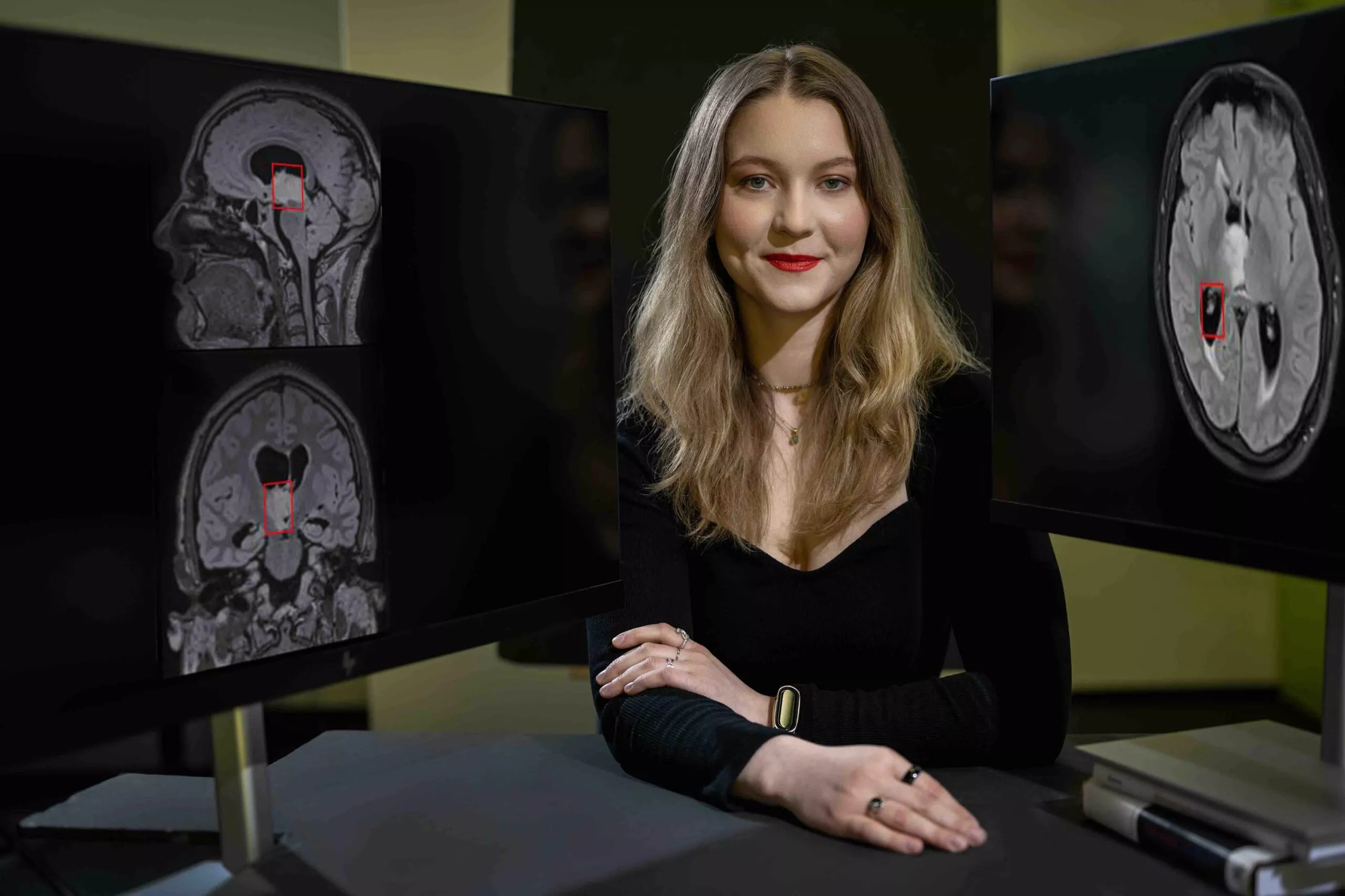
Monika Pytlarz, PhD student in Computational Neuroscience at Sano Centre for Computational Medicine, has won the NCN Preludium grant – Preludium 2025/57/N/NZ7/03738. Her project explores using AI to improve brain metastases tracking by viewing uncertainty as clinically meaningful rather than as error.
The title of the project
Developing an AI algorithm for longitudinal tracking of post-treatment changes in brain metastases using a hybrid Uncertainty-Aware Explainable (UQ-XAI) architecture accounting for inter- and intra-rater variability in segmentations.
The Clinical Challenge in Brain Metastases Monitoring
Accurate monitoring of brain metastases is crucial for effective treatment, yet clinical practice still relies mainly on simple 2D measurements. While AI has advanced in MRI scan analysis, clinicians remain cautious — AI systems often act as “black boxes” without confidence indicators. Even experienced radiologists frequently disagree when segmenting the same lesions, reflecting the complexity of medical image interpretation.
Innovative Solution: Hybrid Uncertainty-Aware Explainable AI
Monika proposes a hybrid architecture that automatically detects and measures brain metastases while clearly indicating prediction uncertainty and explaining which image regions influence decisions. Trained on multi-expert annotated data, the system treats radiologists’ disagreements as valuable information rather than errors.
Clinical Benefits and Real-World Impact
Changes in uncertainty over time can signal heterogeneous treatment responses, enabling physicians to make faster, safer decisions. This approach builds trust in AI and supports precise treatment monitoring.
The project is conducted in collaboration with Children’s Hospital of Philadelphia (CHOP), ensuring access to high-quality clinical data and real-world validation.
Congratulations to Monika on this achievement!
This work in computational neuroscience showcases her innovative approach, paving the way for smart AI solutions to clinical challenges.

#NCN