
Multiscale models for musculoskeletal disease: how can we better combine in vitro and in silico approaches?
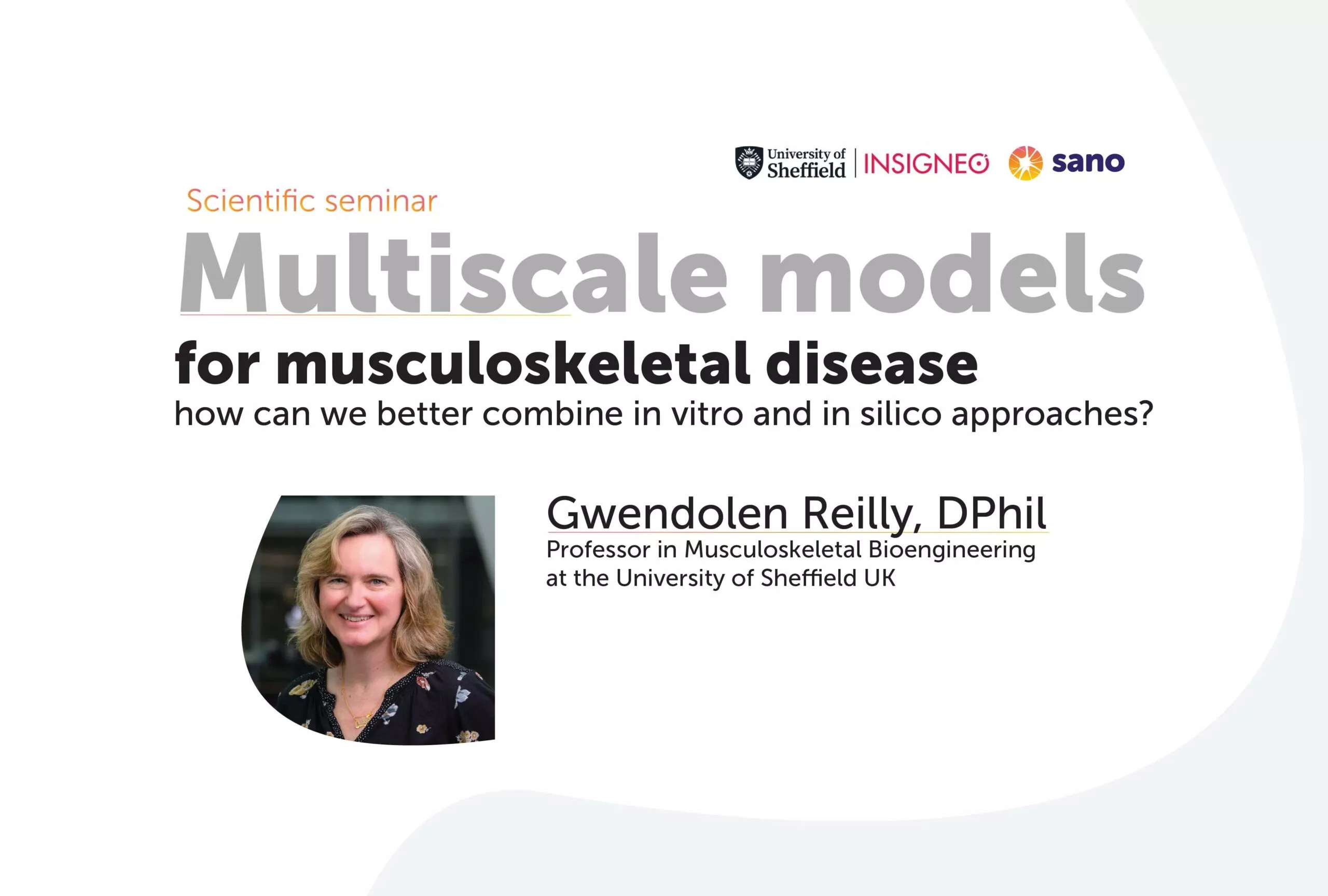
We invite you to a guest lecture by Prof. Gwendolen Reilly from the University of Sheffield, which will take place on 27 March at 10:00 in room 111 at the Sano Centre for Computational Medicine.
Prof. Reilly will present a lecture entitled “Multiscale models for musculoskeletal disease: how can we better combine in vitro and in silico approaches?”. The talk will explore how advanced three‑dimensional in vitro and multiscale computational models of bone and connective tissue diseases can improve our understanding of cell behavior, mechanotransduction, and therapeutic responses.
Lecture’s abstract:
It is becoming well recognized that better 3D and multiscale models of diseases are needed in order to progress pharmaceutical and other therapeutics, with many therapies failing in clinical trials despite passing through animal model systems. In our research group we work on in vitro models, primarily of bone and connective tissues, within a wider team of colleagues that produce in silico models of musculoskeletal disease. Using fibrous polymer scaffolds we guide bone-like collagen orientation in these in vitro systems. Interesting differences can be observed between cell responses at different stages of cell differentiation. These systems are used to study genetic diseases of collagen such as osteogenesis imperfecta. Alternatively using emulsion-templated, polyHIPE scaffolds to create multiscale cell niches we can fabricate ‘bone-on-a-chip’ devices to examine bone and immune cell interactions and cancer invasion to bone. Using these complex 3D environments we can observe the role of mechanical forces and mechanotransduction pathways in bone cell behaviour and mechanical modulation of disease. By combining these with computational models of the musculoskeletal system, the aim is to fully characterize the biophysical environment to better understand mechanisms of action of therapeutic drugs and implant biomaterials.
About the Speaker:
Professor Gwendolen Reilly, DPhil, obtained her PhD in bone biomechanics from the University of York UK in 1998. Since then, she conducted research in the fields of bone mechanobiology and then biomaterials and tissue engineering in institutions in Switzerland (ETH) and the US (Penn State, U. Penn and UIChicago). In 2004 she obtained her faculty position at the University of Sheffield UK where she is now a Professor in Musculoskeletal Bioengineering, working at the School of Chemical, Materials and Biological engineering and INSIGNEO institute for in silico medicine. INSIGNEO works at the interface between medicine and computer modelling to better understand disease and treatment, it is a partner of the Sano Centre for computational personalized Medicine, based in Krakow, Poland. Her research centres around two key themes; the effects of mechanical stimulation on differentiation and matrix formation by bone cells and the interactions between precursor bone cells and their biomaterial substrates. Recently her group has been focused on improving 3D tissue engineered models of bone to create humanised in vitro bone matrices that replicate important feature of bone matrix. We believe that accurate 3D models including bone’s complex, multiscale, hierarchical structure are needed to facilitate more relevant bone disease research than allowed by 2D culture or animal models. Gwen has published 100+ papers and 6 book chapters in these areas. She is past president of the European Society for Biomechanics.