

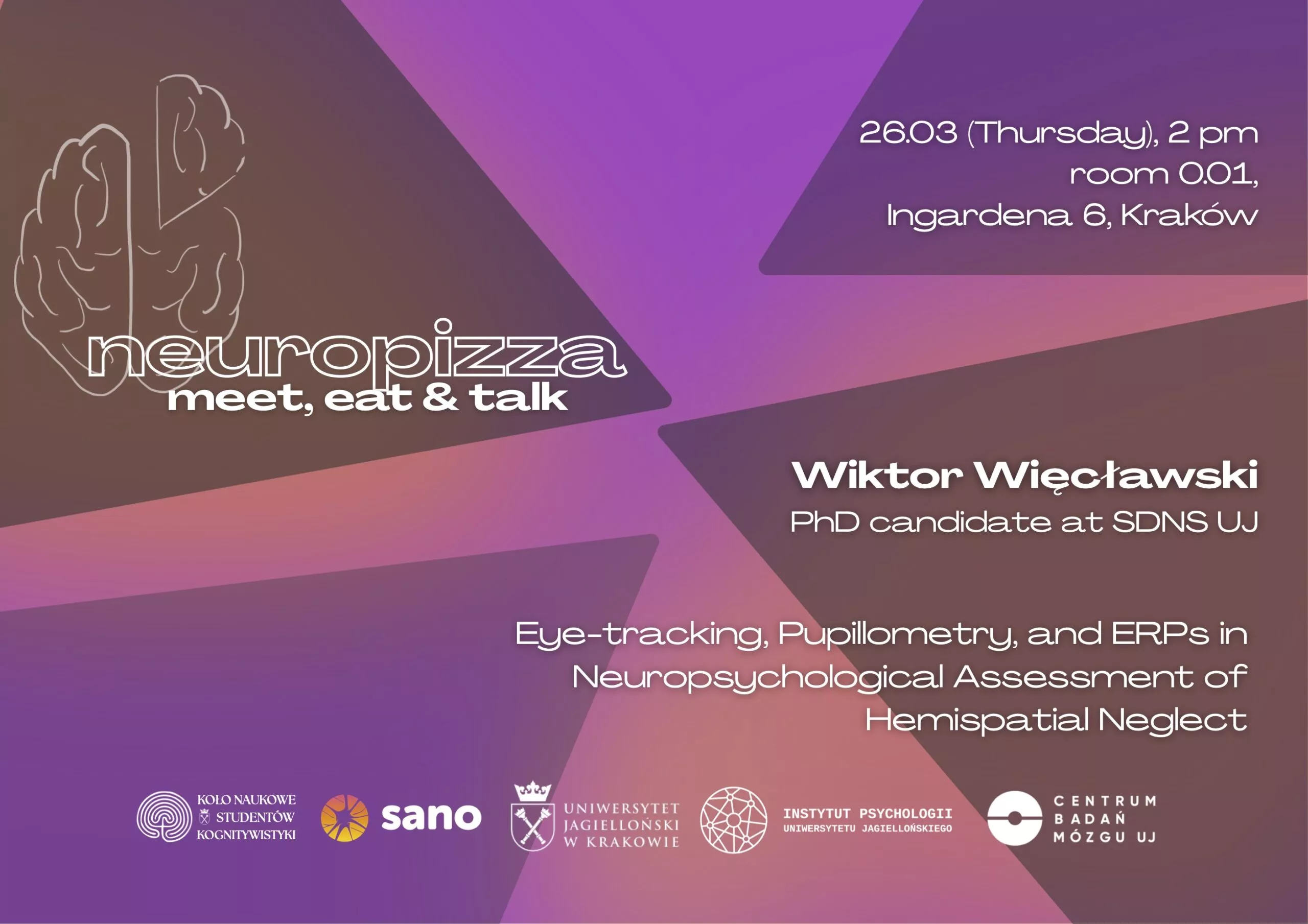
Eye-tracking, Pupillometry, and ERPs in Neuropsychological Assessment of Hemispatial Neglect
Wiktor Więcławski, PhD candidate at SDNS UJ
Diagnosing hemispatial neglect is a nontrivial challenge. When a patient appears to ignore events on one side of space, several different mechanisms may underlie this behavior. The deficit may reflect a visual field loss, apraxia, a motor impairment, or a bias in the orienting of spatial attention toward the ipsilesional side. Moreover, multiple deficits may co-occur and jointly contribute to the observed behavioral impairment.
Current neuropsychological diagnosis relies primarily on clinical observation, standardized tests, and paper-and-pencil tasks. However, these methods have important limitations, and additional sources of objective information are needed to improve clinical assessment. Fortunately, advances in cognitive neuroscience provide promising tools that may complement traditional neuropsychological approaches.
In this talk, I will present several methods that leverage eye-tracking (free visual exploration), pupillometry (split-screen task), and event-related potentials (ERPs; auditory Posner task). I will discuss methodological challenges that arise when assessing cognition after stroke and illustrate how these techniques may help overcome some of the limitations of current diagnostic practices.
Date: Thursday, March 26, 2026
Time: 2:00 PM CET
Venue: Instytut Psychologii Uniwersytetu Jagiellońskiego, room 0.01, Ingardena 6, Kraków
Organizers: STUDENT SCIENTIFIC CIRCLE COGNITIVE SCIENCE, SANO, JAGIELLONIAN UNIVERSITY IN KRAKOW, INSTITUTE OF PSYCHOLOGY OF THE JAGIELLONIAN UNIVERSITY, BRAIN RESEARCH CENTER