
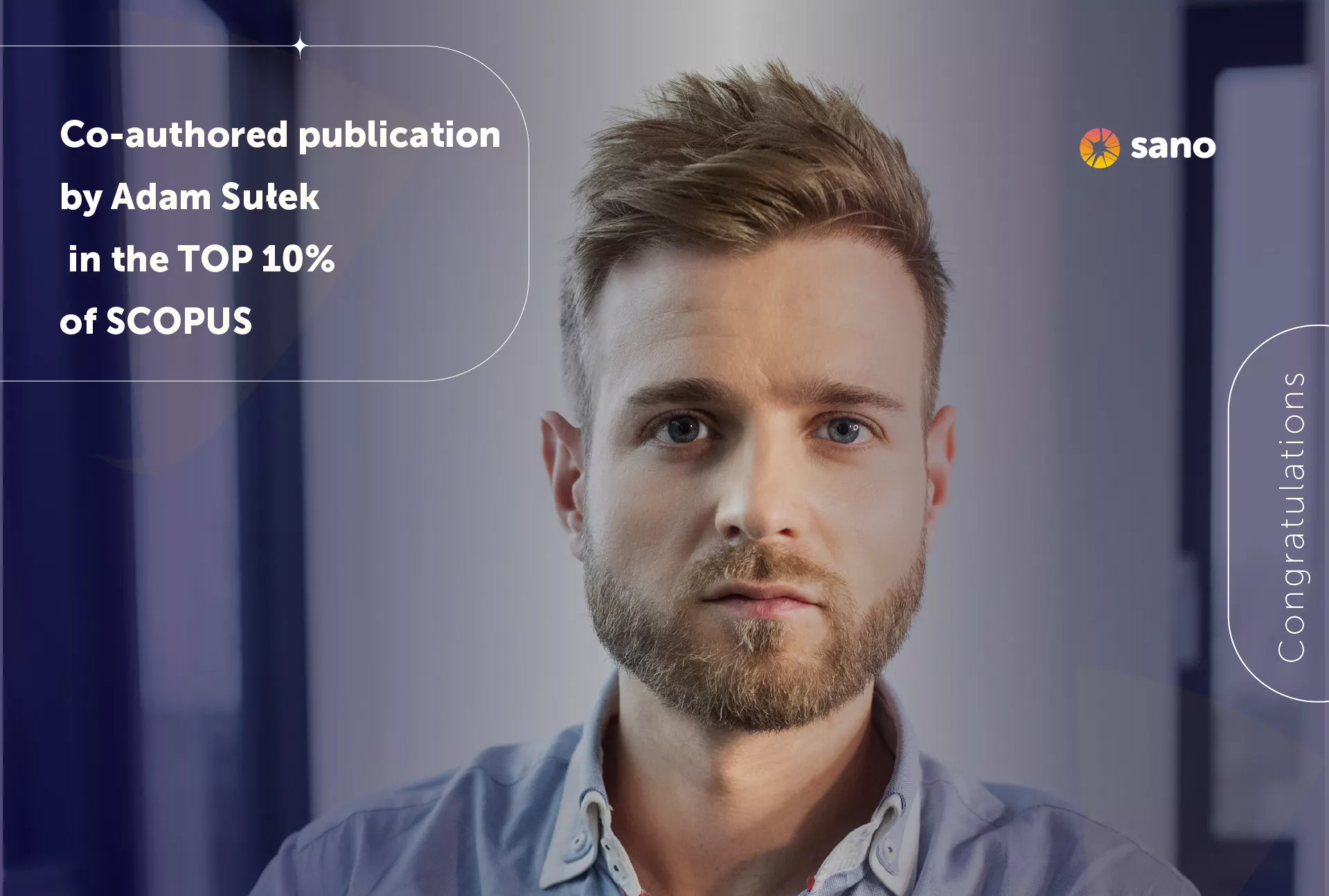
Co‑authored publication by Adam Sułek in the TOP 10% of SCOPUS
How CARS microscopy and artificial intelligence open new opportunities in precision diagnostics and biomedical research.
A publication co‑authored by Adam Sułek from the Structural and Functional Genomics team at Sano has been accepted in a journal ranked among the top 10% of sources indexed in the SCOPUS database. The article “Advancing Label-Free Imaging Through CARS Microscopy: From Signal Formation to Biological Interpretation” was written in collaboration between researchers from Sano and the Biomedical Technologies Centre at Łukasiewicz – Krakow Institute of Technology: Agata Barzowska‑Gogola, Emilia Staniszewska‑Ślęzak, Joanna Budziaszek, Anna Górska‑Ratusznik, Andrzej Baliś, Michał Łucki and Barbara Pucelik. Adam Sułek’s contribution demonstrates the effective combination of expertise in molecular biology, physics and advanced data analysis within projects carried out at Sano.
What is CARS microscopy?
The publication focuses on Coherent Anti‑Stokes Raman Scattering (CARS) microscopy – a nonlinear optical microscopy technique that enables imaging of biological structures without the use of dyes or fluorescent labels. In CARS, the natural vibrations of biomolecular species are exploited, allowing researchers to observe their organization and dynamics in an undisturbed cellular environment. In contrast to classical imaging methods, the CARS signal is coherent and directional, which enables high spatial resolution and fast imaging with reduced load on the sample. This approach is particularly important in modern molecular biophysics, where the aim is to obtain the most faithful, “unperturbed” picture of the studied biological systems.
From signal physics to biological images
The authors provide a detailed description of the physical principles underlying signal generation in CARS microscopy, explaining how the choice of optical parameters affects image quality and sensitivity. They also discuss how different operation modes of a CARS setup make it possible to selectively enhance vibrations of specific chemical groups within biomolecules. As a result, CARS supports chemically selective, time‑resolved imaging of molecular classes such as lipids, proteins and nucleic acids, without the need for labeling. This translates into more reliable information on the structure and function of biological systems – from single cells to complex tissues.
New technologies and the role of artificial intelligence
The publication highlights the latest technological advances in the field of CARS, including the development of laser systems, detection schemes and data analysis tools. Particular attention is given to the integration of CARS with multimodal imaging platforms that combine several complementary techniques within a single system. The authors also point to the growing potential of artificial intelligence and advanced computational analysis for the automated interpretation of complex image datasets generated by CARS. Machine learning algorithms can support structure segmentation, tissue classification and the detection of subtle changes associated with disease processes, bringing this technology closer to applications in precision medicine.
Applications in medicine and life sciences
The article discusses a broad range of potential applications of CARS microscopy in molecular biophysics, cell biology and precision medicine. This technique can be used, among other things, to study lipid organization in cell membranes, monitor metabolic processes and analyse changes within the tumour microenvironment. Studies show that CARS makes it possible to convert subtle molecular vibration signals into rich information on the structure and functioning of biological systems, opening the way towards more personalized diagnostics. This illustrates how combining physics, molecular biology and data analysis can lead to new tools for therapy and disease monitoring.
Congratulations
Congratulations to the entire team of authors – Adam Sułek, Agata Barzowska‑Gogola, Emilia Staniszewska‑Ślęzak, Joanna Budziaszek, Anna Górska‑Ratusznik, Andrzej Baliś, Michał Łucki and Barbara Pucelik. This success shows how combining expertise from different fields can genuinely push the boundaries of what we know about how cells and tissues work.
Read the article