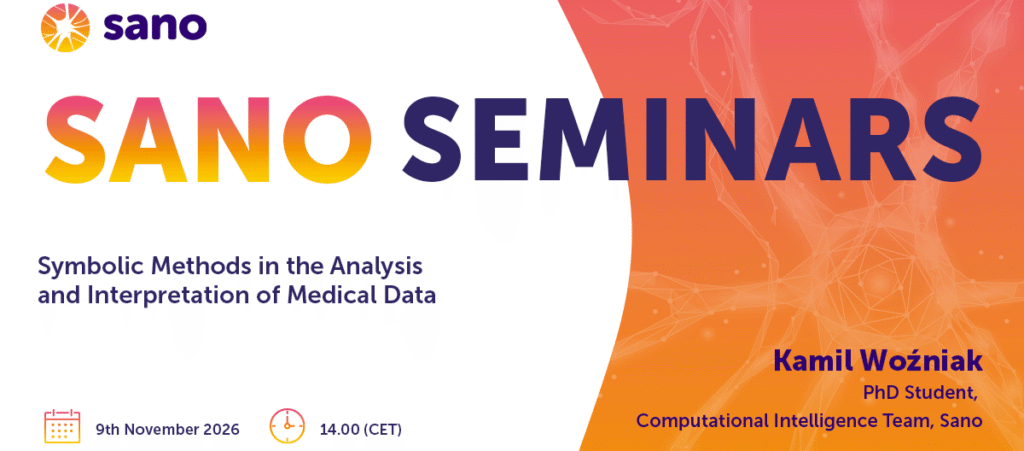
205. Symbolic Methods in the Analysis and Interpretation of Medical Data
Kamil Woźniak, PhD Student, Computational Intelligence Team, Sano Centre for Computational Medicine, Krakow, PL
Abstrakt:
The application of machine learning and artificial intelligence in the field of medicine presents a number of specific challenges. Medical data is difficult to access and costly to obtain, and the amount of such data is limited. Furthermore, patient records are often incomplete. Their sensitive nature also requires special care to protect patient privacy. At the same time, the ability to understand and verify why a particular decision was made takes on particular significance. An important area of research focuses on methods that offer concise and understandable explanations as an alternative to or complement of powerful black-box models. The presentation will focus on selected topics related to the development and application of interpretable and privacy-preserving methods in medical data analysis. The topic of learning from small medical datasets will be discussed, including the use of abstractions that support rule induction. Approaches to federated learning, particularly rule-based approaches, will also be discussed. Another topic will be a mechanism for acquiring missing data that uses rule-based reasoning to support the selective acquistion of relevant information for decision-making purposes. This will be complemented by the use of a rule-based approach to create a concise and interpretable representation of knowledge extracted from non-tabular data modalities. A common theme across the topics discussed is the effective use of limited, sensitive and often fragmented medical data. This is achieved by identifying the relationships within the data and presenting them as clear, actionable insights to support decision-making.
About the author:
Kamil has a master’s degree in computer science and at Sano he continues his development in this field as a PhD student, where he works on combining statistical and symbolic approaches to artificial intelligence and its application to biomedical data. He is also interested in integrating data of various types (including laboratory measurements, imaging and written text) and combining them into higher-level abstractions.