
Science for everyone?
What we brought home from SPIN 2026 in Kraków
Can science really be for everyone? It sounds like a simple question, but anyone who has ever tried to explain an algorithm to their family over Sunday lunch knows it isn’t. That question was the starting point of the SPIN 2026 Conference, held on 6–8 October at the Małopolska Science Centre Cogiteon in Kraków. Sano was a partner of the event, and we took part both on stage and in the audience. We came back with plenty to think about.
A meeting of bridge builders
SPIN is the national conference of the Society and Science Association (Stowarzyszenie Społeczeństwo i Nauka SPIN). This year it was hosted by Cogiteon. Its theme, “Science for everyone?”, deliberately ended with a question mark. Around 250 people from all over Poland took part: representatives of science centres, museums, universities, cultural institutions and organisations working in science communication.
What do these people have in common? In their day-to-day work, they build bridges between laboratories, museums, science centres and the rest of the world. Some do it through interactive exhibitions, others through lectures, workshops, films or graphics. Over three days, the programme offered more than 30 sessions, workshops, debates and expert panels, as well as keynote lectures and study visits to the Wieliczka Salt Mine and the Aviation Education Centre at Kraków Airport. The NOKTURN evening event brought science, art and networking together, and Marta Banaszak’s exhibition “Her Majesty Geometry” reminded participants how closely geometry, art and perception are intertwined.
The topics on the agenda show how much the field has grown. Discussions covered inclusion and accessibility, the meeting point of art and science, new technologies and artificial intelligence, modern ways of popularising science, and citizen science, in which non-specialists do not just learn about research but actively take part in it.
Behind the scenes of Sano’s science communication
Our Visual Content Creator, Kamil Pilch, took the floor for a short talk, inviting the audience behind the scenes of science communication at Sano. Our centre works in computational and personalised medicine. In short, this means using computer models, simulations and data analysis to better understand disease and to tailor diagnosis and treatment to an individual patient. It is a fascinating field, but also an abstract one. A simulation of blood flow or an algorithm that learns from thousands of medical images does not look like much on its own.
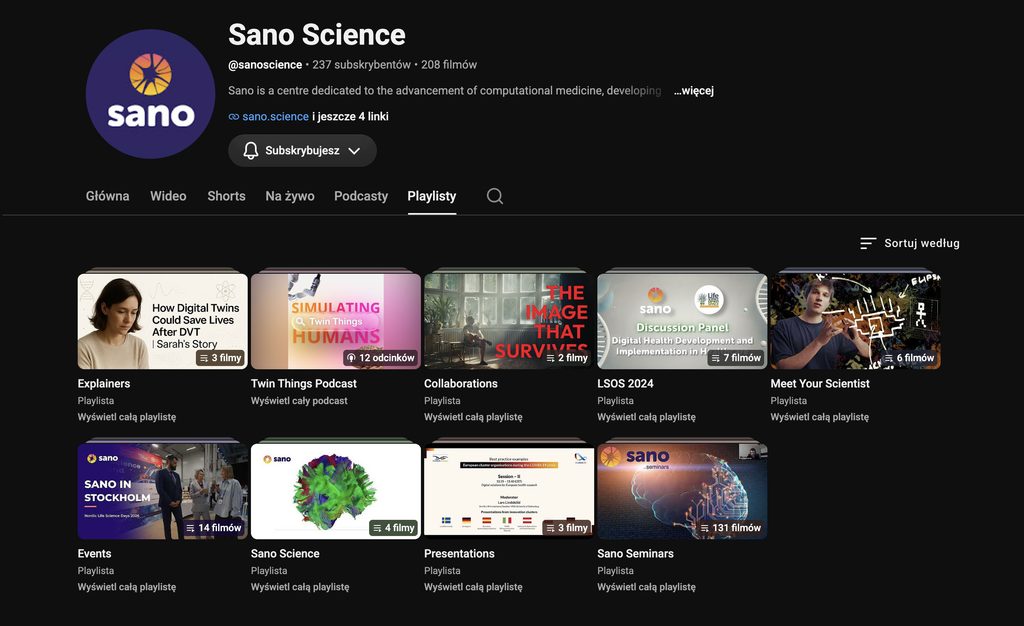
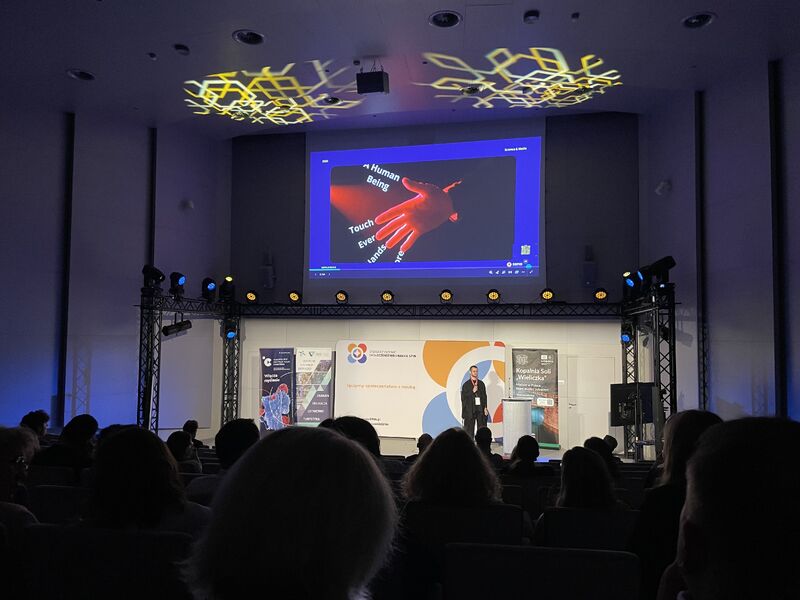
Kamil showed how we turn this kind of work into visual stories that people outside the research community can follow. The key challenge, he explained, is balance. An image has to catch the eye, but it cannot oversimplify the science behind it. A graphic that looks beautiful but tells a story the researchers would not sign off on is a failure, and so is a scientifically flawless chart that nobody can read. This is a question we ask ourselves with every graphic, animation and video we make: how do we stay accurate and still be understood?
Cheering him on from the audience were his colleagues from Sano’s Communication team, Katarzyna Baliga-Nicholson and Anna Partyka. For us, it was also a chance to listen, compare notes with other institutions and see our own work from a new perspective.
Why sharing knowledge matters
Science communication is still a young profession, and much of what works is learned by trial and error. When a science centre shares how it made an exhibition accessible to blind visitors, or a university explains how it involved local residents in a research project, others do not have to start from scratch. Good practices spread faster, and the same mistakes are repeated less often.
This matters especially in fields like ours. Personalised medicine and artificial intelligence in healthcare will affect patients, doctors and decision-makers who are not specialists. If people are to trust these tools and use them wisely, they need to understand, at least in broad terms, how they work and where their limits lie. Communicating research clearly is therefore not an add-on to science, but part of its responsibility to society.
The question mark in the conference title was well chosen. Science is not automatically for everyone. It becomes accessible when someone makes the effort to translate it, carefully and honestly, for a particular audience. As we were reminded in Kraków, good science communication starts with two simple questions: who will see this, and what should they remember?