

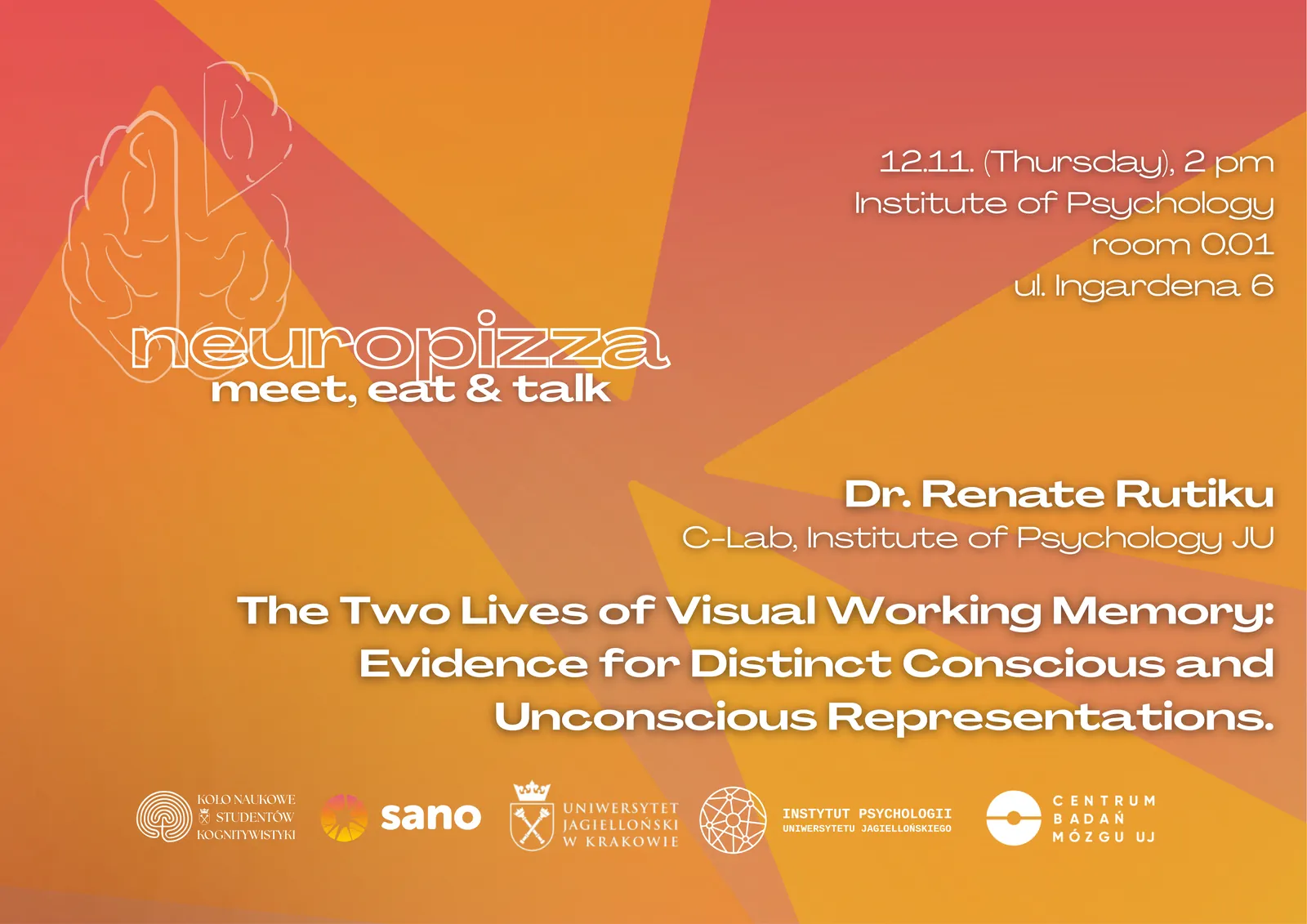
The Two Lives of Visual Working Memory: Evidence for Distinct Conscious and Unconscious Representations
Dr Renate Rutiku
C-Lab, Institute of Psychology JU
Visual working memory (vWM) is often linked to conscious experience and visual imagery, but it is typically described as a system that stores separate, independent items. These assumptions are difficult to reconcile, given the unified nature of conscious experience. Here, we test the hypothesis that vWM relies on at least two distinct representations: an underlying, unconscious memory trace and a consciously accessible, integrated representation.
A total of 216 participants performed a change-detection task, in which they rated their perceptual awareness of the memory display during the maintenance interval. Critically, we manipulated the statistical properties of the displays (average item size and size variability) to probe sensitivity to unified ensemble-level structure. Results revealed a dissociation between subjective and objective measures. Perceptual awareness increased for displays with larger, more variable items, whereas objective performance improved for displays with smaller, less variable items.
Despite this difference, subjective awareness still predicted performance, and even incorrect responses showed consistent biases rather than random guesses. Importantly, individual differences in imagery vividness (VVIQ) were selectively associated with subjective awareness and estimation bias, but not with objective correctness. These precision biases were further shaped by display statistics, suggesting that multiple representations can guide behavior.
Together, our findings support a reinterpretation of vWM performance in which task responses can draw on both unconscious and consciously accessible representations. One possible explanation for these behavioral patterns is that subjective experience reflects integrated, ensemble-like representations, while objective performance depends more strongly on item-specific information.
12.11. (Thursday), 2 pm
Institute of Psychology room 0.01, Ingardena Street 6