Sano at MedStok #3 in Białystok
Gniewosz Drwięga presented the MultiGeoMed project and its first results
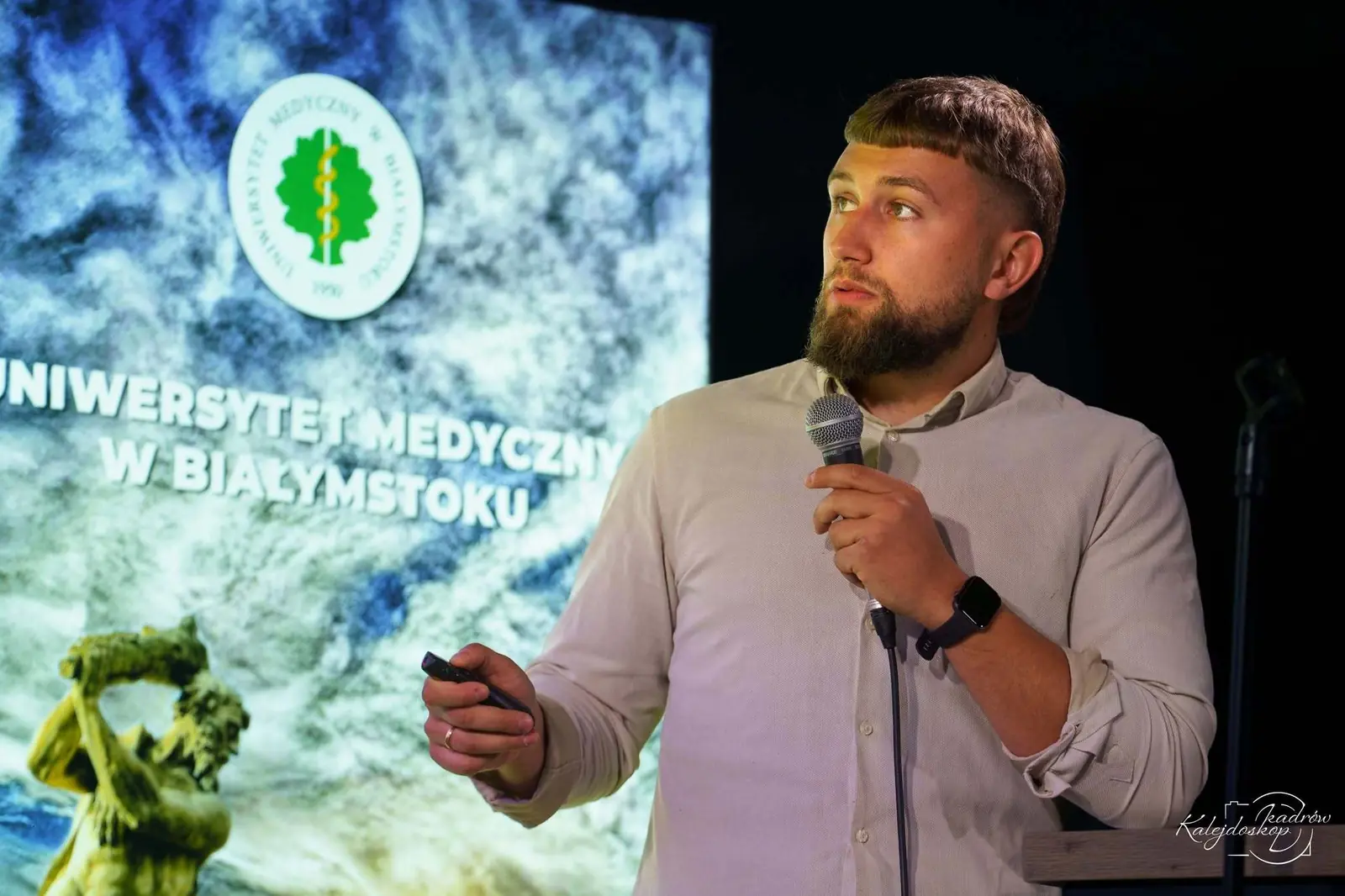
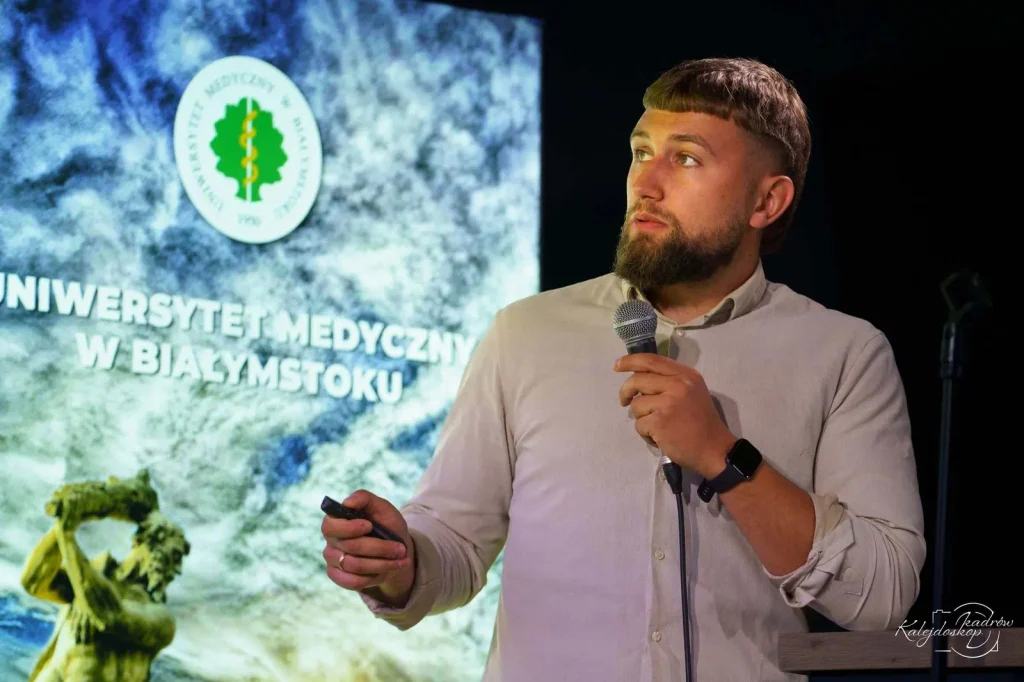
On 13 October 2026, Gniewosz Drwięga, postdoctoral researcher at Sano, gave a talk at MedStok #3 in Białystok. He presented the MultiGeoMed project, funded by the National Science Centre (NCN SONATA, no. 2024/55/D/ST6/02081) and carried out at Sano, together with its first results.
Shape matters in medical imaging
The first part of the talk introduced geometric deep learning. Medical imaging data can be represented in many ways: as voxel grids (3D pixels), surface meshes, point clouds or implicit neural representations. Each has its own strengths. MultiGeoMed explores which representations work best for specific tasks and how to combine them so that AI models better understand anatomy.
Keeping blood vessels connected
The second part focused on blood vessel segmentation, the automatic outlining of vessels in medical images. Gniewosz showed why popular overlap metrics, such as the Dice score, are almost blind to connectivity errors. A single missing voxel can split a vessel in two while barely changing the score, yet it disrupts every later step, from extracting vessel centrelines and labelling branches to simulating blood flow.
He presented the team’s method for repairing such errors. A deformable surface mesh is fitted to the predicted vessel mask and then used as a geometric scaffold to restore broken connections. The results, presented at the ShapeMI workshop during MICCAI 2026, cover three vascular anatomies: the aorta, the circle of Willis (the ring of arteries at the base of the brain) and the pulmonary arteries. Connectivity improves markedly, while voxel-level accuracy remains practically unchanged.
What’s next
Gniewosz closed with a brief look at the project’s next steps: foundation models for shape reconstruction (large AI models that can be adapted to many tasks) and the analysis of histopathology images (microscope images of tissue samples).
About the speaker
Gniewosz holds a PhD in systems neuroscience from Jagiellonian University, where he later worked as an assistant professor in the Department of Computational Biophysics and Bioinformatics. There he analysed electrophysiological, anatomical and behavioural data, built deep learning pipelines to automate data processing and track animal movement in experiments, and worked with ultrasound imaging of mouse tumour models. At Sano, his research focuses on topology-aware automatic segmentation of medical images using multimodal geometric deep learning.
The visit to Białystok was a chance to share Sano’s research, exchange knowledge with medical imaging and machine learning professionals, and build contacts for potential scientific collaborations.