HomeNewsEngineering Bones: A Multiscale Look at Musculoskeletal Health
Engineering Bones: A Multiscale Look at Musculoskeletal Health
A Sano Seminar lecture by Gwendolen Reilly explores how engineering and biology come together to understand and treat diseases of the musculoskeletal system.
Where Engineering Meets Biology
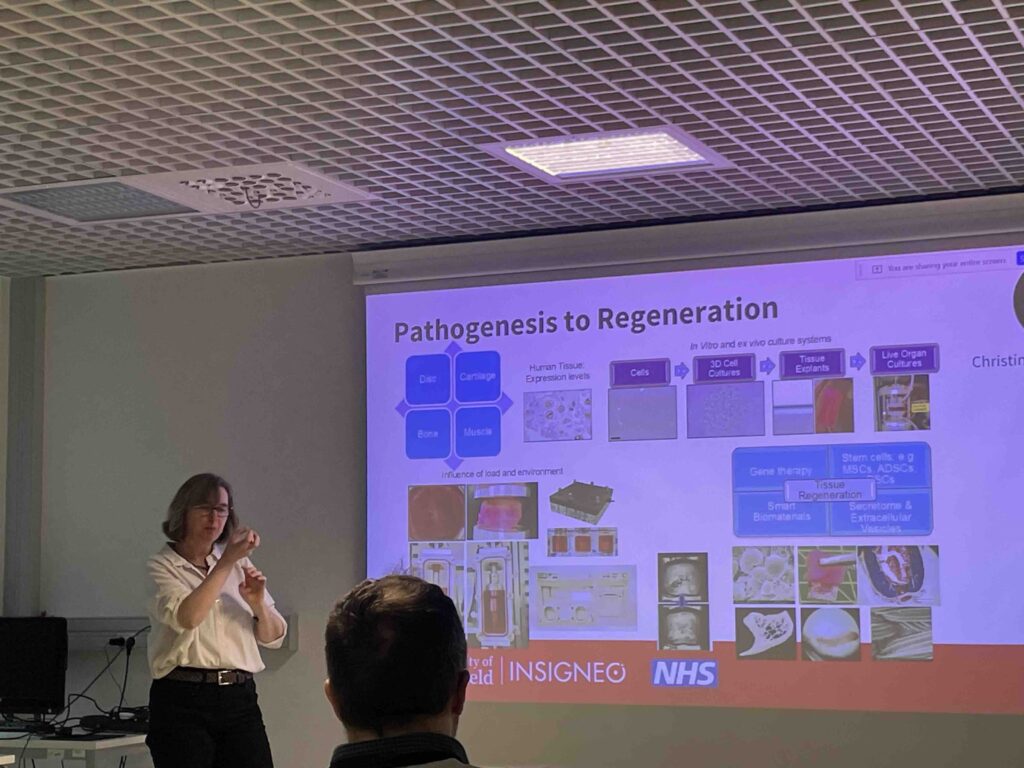
As part of the Sano Seminars series, we had the pleasure of hosting Gwendolen Reilly, Professor of Musculoskeletal Bioengineering at the University of Sheffield in the United Kingdom. In her lecture, she showed how modern science combines biology, materials engineering, and computational modeling to better understand diseases affecting bones and joints—and ultimately to develop more effective treatments.
A Multiscale Perspective on Bone Health
The musculoskeletal system is far more complex than it may seem at first glance. It not only enables movement but also provides the structural support that keeps the body stable. Disorders affecting this system—from traumatic injuries to degenerative diseases—are among the most common causes of pain and reduced mobility. For this reason, researchers increasingly study it using a multiscale approach, examining processes at many levels: from the biomechanics of the entire body, through individual organs such as the spine or joints, down to cells and the microscopic structure of bone tissue.
Mechanobiology and Living Bone
One particularly fascinating field discussed during the seminar was mechanobiology—the study of how cells respond to mechanical forces such as pressure, stretching, or fluid flow. Bone cells are able to “sense” these physical cues and adapt their activity accordingly, for example by increasing the production of minerals that strengthen the tissue. This means that bones are not static structures; they are dynamic tissues that constantly remodel themselves in response to the loads placed on the body.
Biomaterials and Computational Models
To investigate these processes more closely, researchers use advanced biomaterials and three-dimensional tissue scaffolds that mimic the natural environment of bone. These structures can be created using techniques such as 3D printing or specialized polymer fabrication methods.
In laboratory settings, they serve as realistic models for studying bone diseases and testing new therapies, while in the future they may also become the basis for implants that support the regeneration of damaged tissues.
Another key topic of the lecture was the growing role of computational modeling in biomedical research. Computer simulations allow scientists to analyze complex biological processes, test different treatment scenarios, and design new biomaterials before they are ever produced in the lab. In the long term, such approaches may lead to the development of digital models of patients, helping clinicians choose more personalized and effective therapies.
Interdisciplinary Science in Action
A recurring theme throughout the talk was the importance of interdisciplinary collaboration. Research on the musculoskeletal system brings together experts from many fields, including biology, medicine, materials science, physics, and computational science. Only by combining these perspectives can scientists fully understand the complex mechanisms that shape the health and function of our bones and joints.
Watch the Seminar Recording
The lecture took place on March 27 as part of the Sano Seminars series. A recording of the event is available on Sano’s YouTube channel.