

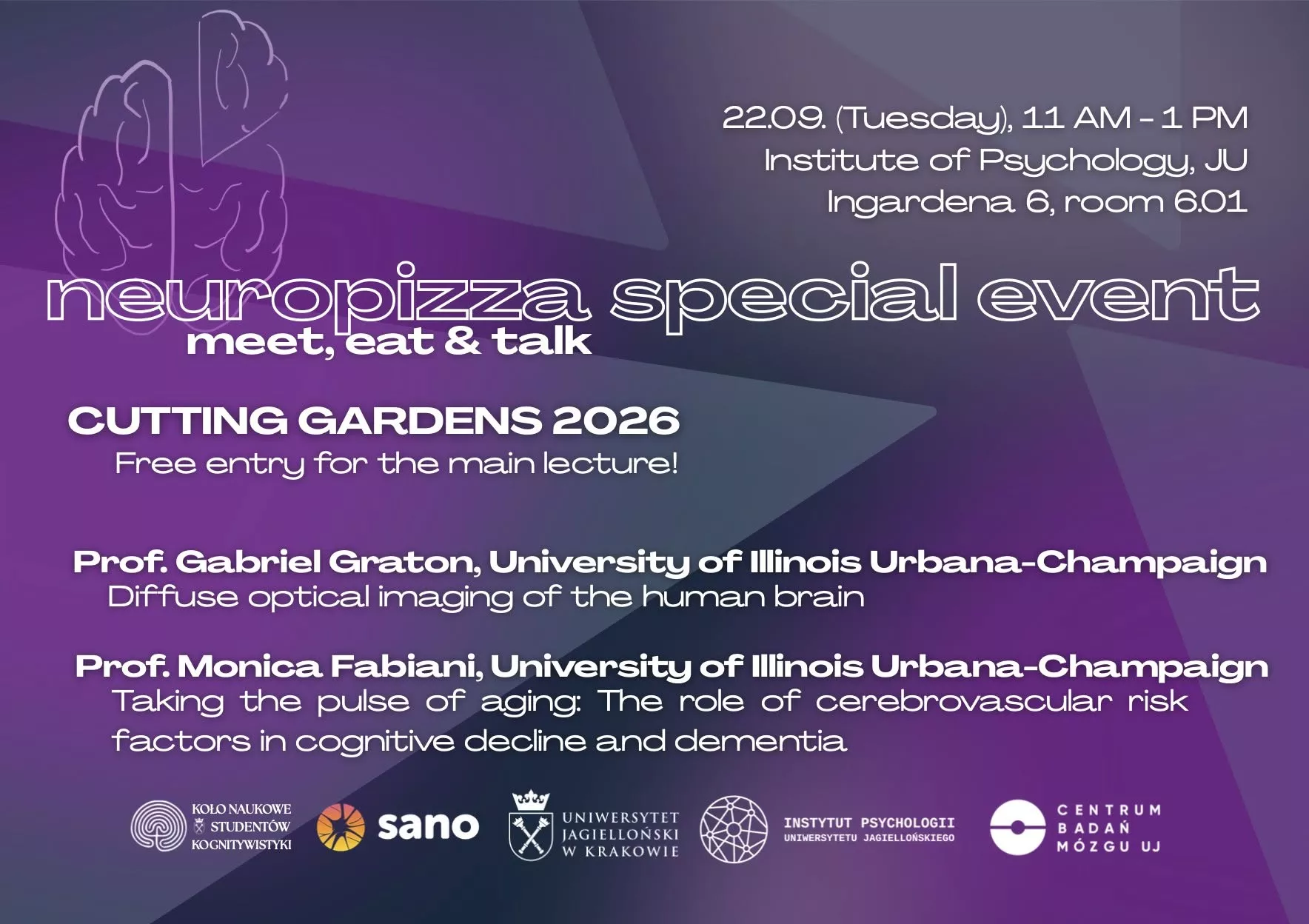
NEUROPIZZA — special edition at Cutting Gardens 2026
We invite you to a special edition of Neuropizza, held as part of the international Cutting Gardens 2026 conference. During the meeting, we will have the opportunity to hear two talks by researchers from the University of Illinois Urbana-Champaign:
“Diffuse optical imaging of the human brain – Prof. Gabriel Graton, University of Illinois Urbana-Champaign
Diffuse optical imaging is a tool for studying the intrinsic optical properties of deep tissues, such as the human brain, in a non-invasive manner. Observable signals include changes in tissue transparency (related to both absorption and scattering) that may occur slowly over the lifetime, because of brain atrophy in aging, but also very rapidly as a function of changes in brain hemodynamics, arterial pulsation, neural activity and brain oscillatory activity. Our lab has provided critical advancement in the measurement of the arterial pulse and of fast neural activity. In my presentation I will focus on the types of functional brain measures that can be obtained with diffuse fast optical signals. This research demonstrate that diffuse optical imaging can provide measures of brain function combining high spatial and temporal resolution, allowing us to analyze the spread of neural activity during the processing of external stimuli and in preparation for motor activity. I will present examples of the application of these measures to the study of the brain processes associated with many psychological phenomena, including selective attention, perceptual categorization, language processing, sensory and working memory, conscious perception and awareness, task switching and cognitive control.
Taking the pulse of aging: The role of cerebrovascular risk factors in cognitive decline and dementia – Prof. Monica Fabiani, University of Illinois Urbana-Champaign
Cerebrovascular support is critical for healthy cognitive aging. Reduced cerebral blood flow in aging is caused, among others, by hypertension, arteriosclerosis (i.e., stiffening of the arteries) and plaque formation. Cerebral arterial stiffness is predictive of cognitive decline, is a Critical risk factor for cerebrovascular accidents, and has been linked to heightened risks for Alzheimer’s Disease and other forms of dementia. I will discuss data obtained in our laboratory with new non-invasive measures of cerebrovascular health (pulse-DOT, a diffuse op6cal tomographic method for studying cerebral arteriosclerosis), in conjunction with structural and Functional MRI measures and cognitive assessments of fluid abilities and working memory. These findings support a model in which arteriosclerosis mediates structural and functional brain changes, leading to cognitive declines in fluid abilities, and paving a way for individualized Interventions to prevent or delay age-related cognitive decline.
Where: Institute of Psychology, Ingardena 6, room 6.01
When: 22.09.2026 (Tuesday), 11am-1pm
Hope to see You there!
Neuropizza team