
Representatives of the Structural and Functional Genomics Team at the international conference in London
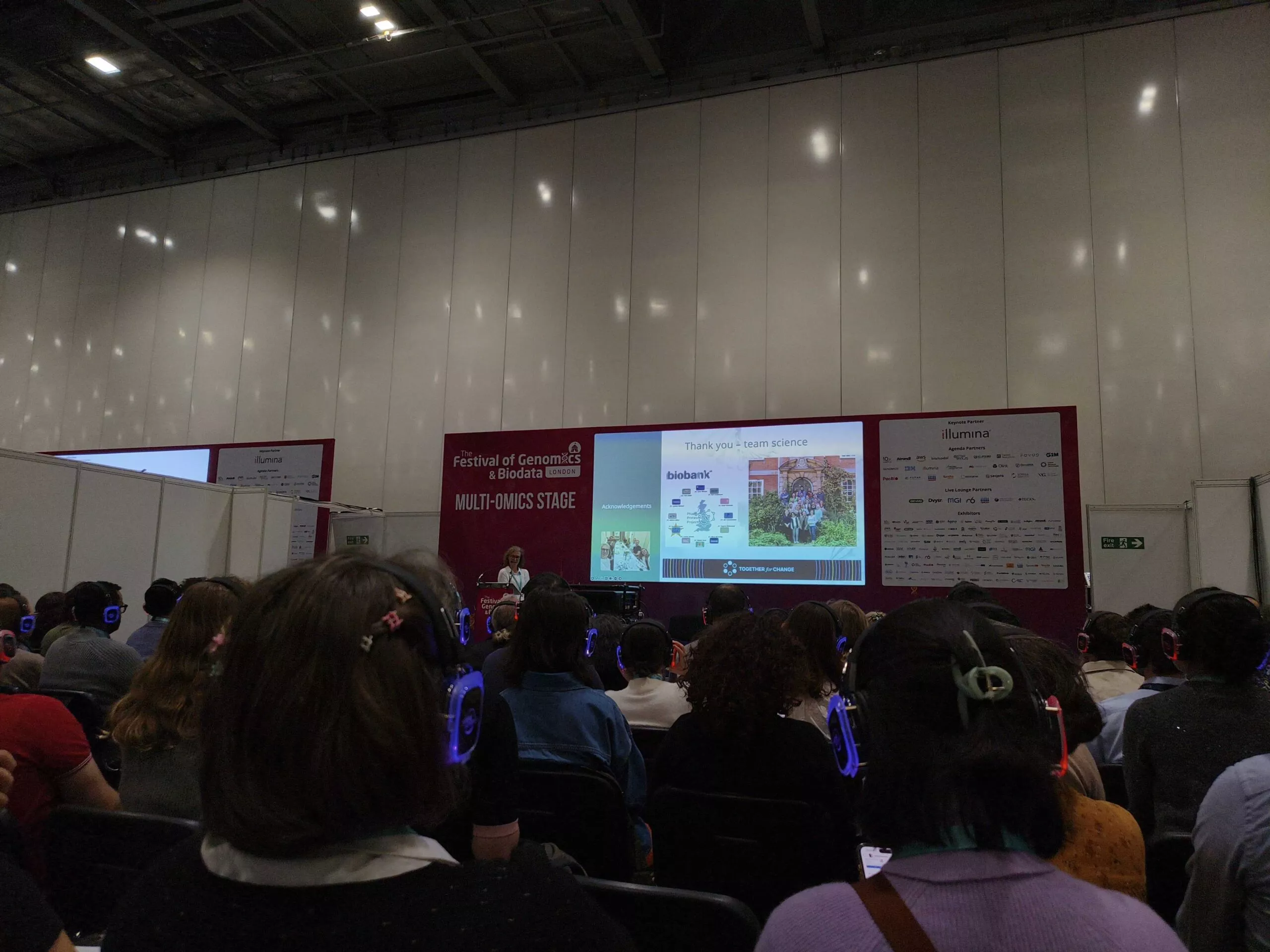
THE FESTIVAL OF GENOMICS & BIODATA- UK’s largest Life Sciences event
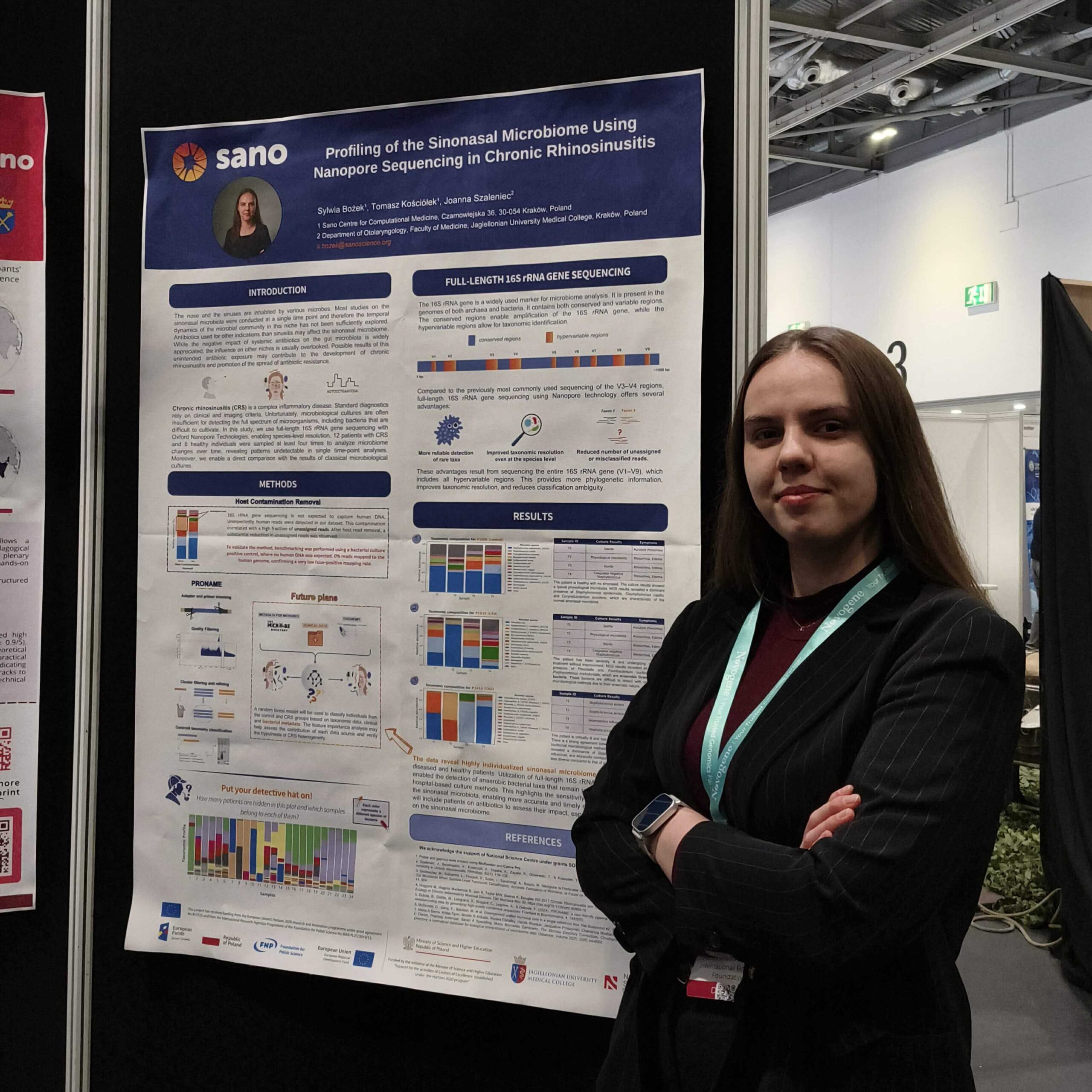
At the poster session in London, Sano was represented by members of the Structural and Functional Genomics Group. Sylwia Bożek presented work on sinonasal microbiome. Daryna Yakymenko bioinformatics capacity in Central and Eastern Europe.
“The sinuses are inhabited by various microbes. Most studies on the sinonasal microbiota were conducted at a single time point and therefore the temporal dynamics of the microbial community in this niche has not been sufficiently explored. Chronic rhinosinusitis (CRS) is one of the most common and complex inflammatory diseases affecting the sinuses. Advances in molecular techniques, particularly third-generation and long-read sequencing, now enable species-level resolution in microbiome profiling. In this study, we applied full-length 16S rRNA gene sequencing using Oxford Nanopore Technologies. Our analysis demonstrates that the sinonasal microbiome of CRS patients and healthy individuals exhibits high inter-individual variability, without consistent taxonomic patterns distinguishing the groups. Future work will investigate the effects of systemic antibiotic therapy on the sinonasal microbiome. We also aim to integrate taxonomic data with clinical and microbial metadata derived from bioinformatic analyses, using machine learning approaches to better understand disease complexity and identify meaningful patterns..”
The project is carried out in collaboration and funded by the grant “Microbiome of the paranasal sinuses – temporal dynamics and changes induced by selective antibiotic pressure” from the National Science Centre (NCN), grant no. 2023/51/D/NZ5/01206, led by Dr Joanna Szaleniec.
Sylwia Bożek
“In today’s world, where life-science research is becoming increasingly data-driven, unequal access to formal bioinformatics training constitutes a major barrier to the effective use of insights derived from continuously generated biological big data. To address this gap in Central and Eastern Europe, we developed a comprehensive framework to strengthen regional bioinformatics capacity through intensive, targeted short-term workshops delivered in a hybrid format. Implemented through the East European Bioinformatics and Computational Genomics (EEBG) workshop series, the initiative combines hands-on training with remote participation to maximize accessibility and foster international collaboration.
An evaluation of the 2025 EEBG workshop in Kraków, which engaged over 110 on-site and online participants, revealed high satisfaction with skill development and networking opportunities, while also identifying challenges typical of hybrid education, including the reliability of audio-visual infrastructure and the need to balance pacing across participants with diverse levels of experience. Based on these observations, we propose refinements and outline core design principles for effective and scalable bioinformatics training. Overall, our findings demonstrate that our developed framework of regionally adapted hybrid workshops provides a scalable and effective solution for narrowing the global bioinformatics skills gap.”
The research was conducted in collaboration with Jagiellonian University Małoposka Centre of Biotechnology, Jagiellonian University in Krakow, Oakland University (USA) and others and is available as a preprint: https://www.biorxiv.org/content/10.64898/2026.01.21.700760v1.full.
Daryna Yakymenko
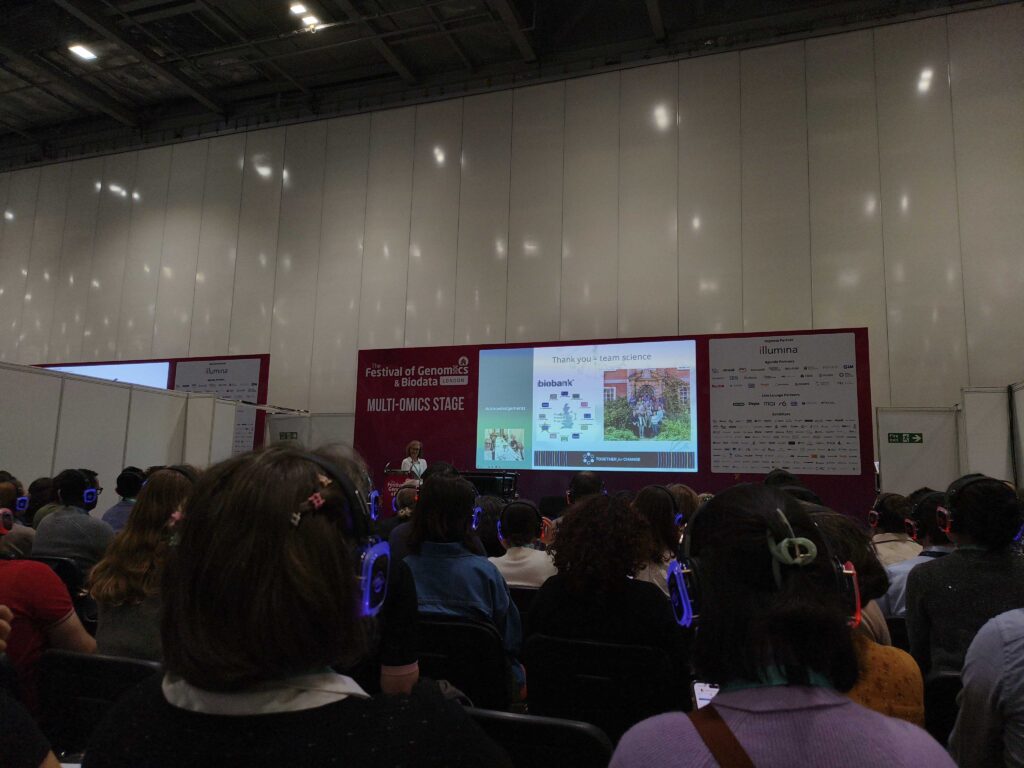
The Festival of Genomics & Biodata was the UK’s largest life sciences event, focused on advancing the adoption and application of genomics across biomedical research and healthcare. The festival covered a broad spectrum of topics, including diagnostics, cancer research and drug discovery, applications of AI in medicine, proteomics, microbiome studies, and single‑cell analysis.
Over the years, the event has evolved into a dynamic and interdisciplinary platform where scientists, scholars, business leaders, technology companies, investors, patient organizations, and policymakers gather to learn, connect, collaborate, and share expertise – all with the shared goal of translating the latest scientific and technological advances into tangible improvements in patient outcomes.
This year’s program featured a diverse mix of micro‑events, workshops, round‑table discussions, and a large exhibition hall that hosted over 180 exhibitors, along with numerous opportunities for networking and partnership building.
Among the distinguished speakers were Zubir Ahmed (Parliamentary Under‑Secretary of State for Health Innovation and Safety, Department of Health and Social Care), Sir Rory Collins (Chief Executive, UK Biobank), Sir Stephen Fry, Lord Patrick Vallance (Minister of State for Science, Research and Innovation), and Dame Anna Dominiczak (Chief Scientific Adviser for Health, Scottish Government).
This renowned scientific and industry event once again bridged genomics, biodata analysis, and cutting‑edge technologies, demonstrating their growing impact across biomedical research and clinical practice.