
Sano at Discovery & Development Europe 2026
Adam Sułek presented a poster on AI-enabled antibiotic discovery
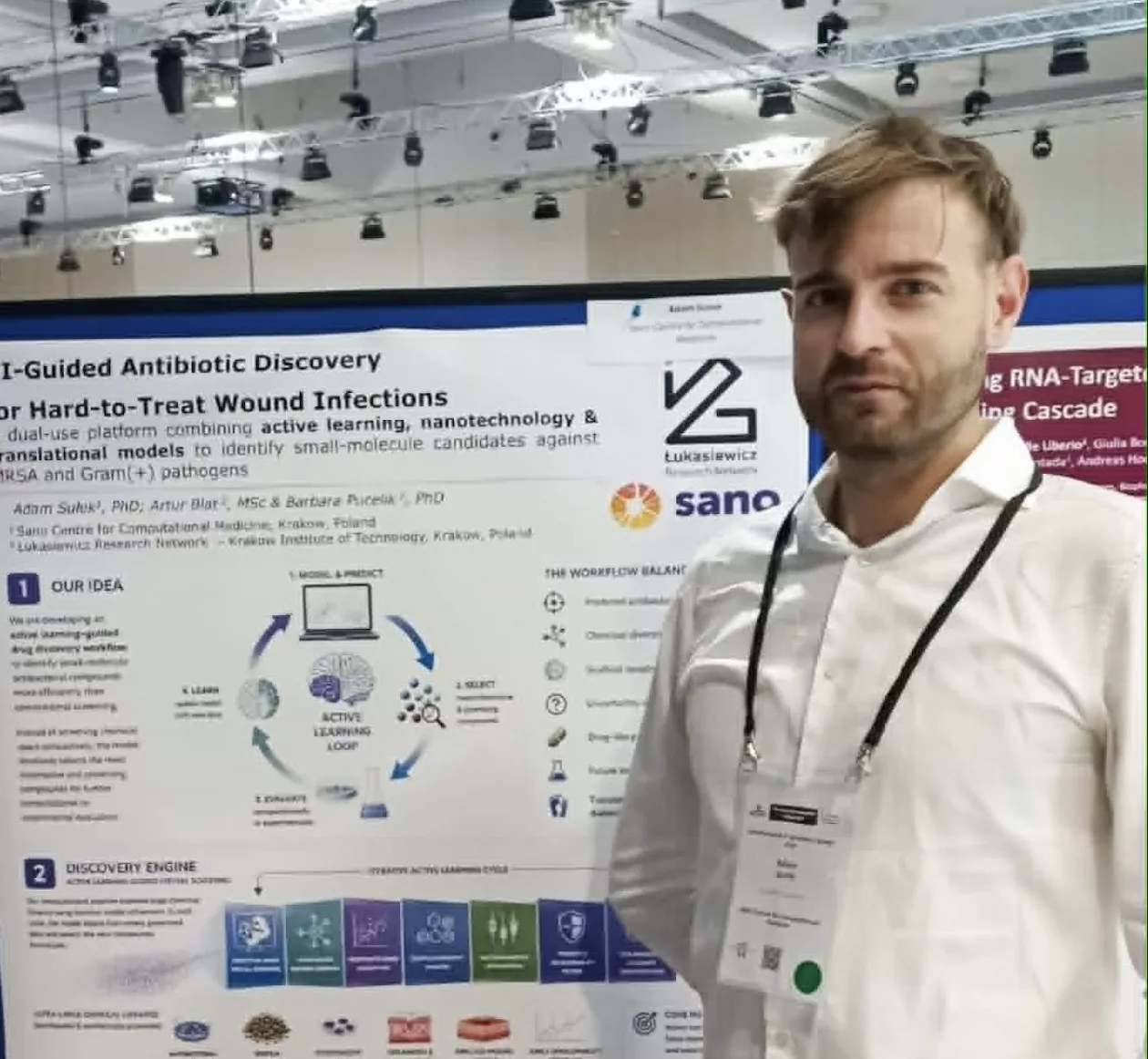
At Discovery & Development Europe 2026, held on 15–16 June at the Estrel Congress Centre in Berlin, Adam Sułek from the Sano Centre for Computational Medicine presented a poster entitled “AI-Guided Antibiotic Discovery for Hard-to-Treat Wound Infections”. The work combines AI-based candidate prioritisation with experimental validation carried out in collaboration with Łukasiewicz, where selected compounds are tested against bacterial strains relevant to wound infections. His contribution aligned with the focus of the event, which is to connect early-stage target identification with later stages of formulation development and the progression of candidates into clinical pipelines. His presence underscored the growing role of computational medicine in modern R&D projects in pharma and biotech, particularly where artificial intelligence supports decision-making in drug discovery.
Conference overview
Discovery & Development Europe by Oxford Global is an annual conference and community that brings together leaders from pharmaceutical and biotechnology companies as well as academic institutions to discuss the entire value chain of novel therapeutics, from early discovery through to advanced development. The event is designed to break down scientific silos and accelerate the journey from target identification to optimised drug products, through parallel thematic tracks, plenary sessions and extensive networking opportunities. The 2026 edition took place in Berlin and continues a series of previous meetings, including earlier editions hosted in Basel.
Discovery & Development Europe consists of several parallel programmes that collectively reflect the key stages of modern therapeutic development. The Drug Discovery Europe track focuses on the earliest phases of R&D, including target identification, lead optimisation and the use of advanced biology and AI in early discovery. Formulation & Delivery Europe is dedicated to translating promising molecules into finished drug products, covering formulation design, analytical development and modern delivery systems for complex modalities. These programmes are complemented by dedicated content on automation, robotics and digitalisation, showcasing technologies that accelerate laboratory workflows and shorten timelines in drug development.
Opening keynote: precision medicine in oncology
The opening keynote, delivered by Professor Paul Workman, explored how precision cancer medicine is transforming clinical practice, showing how new technologies and therapeutic modalities are expanding the druggable genome and improving patient outcomes. His talk emphasised that biomarker-driven approaches are already delivering tangible clinical benefits, while also highlighting the remaining gaps, particularly around target validation, resistance mechanisms and tumour evolution. These themes framed the broader conference agenda, which examined what the next generation of cancer medicines will require from drug discovery science and how data, AI and systems biology can help address current limitations.
Poster: AI in antibiotic discovery
The poster “AI-Guided Antibiotic Discovery for Hard-to-Treat Wound Infections” presented by Adam Sułek fits into a global trend of applying artificial intelligence to accelerate antibiotic discovery in response to rising antimicrobial resistance. It focuses on hard-to-treat wound infections, often caused by multidrug-resistant pathogens that pose serious clinical challenges and limit the effectiveness of current therapies. AI‑guided discovery pipelines make it possible to narrow down vast chemical spaces to a manageable set of high-priority candidates, which can then be validated experimentally, reducing both the time and cost associated with traditional high-throughput screening. The project also benefits from collaboration with Łukasiewicz, where selected AI-prioritised compounds are experimentally tested against bacterial strains relevant to wound infections. This wet-lab validation step is essential for confirming whether computationally identified candidates translate into measurable antibacterial activity and provides feedback for improving subsequent rounds of AI-guided compound selection.
Start-Up Zone and networking
Discovery & Development Europe also featured a dedicated Start-Up Zone, where emerging companies presented innovative solutions in drug discovery, advanced manufacturing, biomaterials and AI applications, with direct access to investors and biopharma leaders. This area complemented the broader networking programme, including exhibition spaces and numerous one-to-one meetings, which facilitated partnerships across academic, industrial and technology stakeholders. In this context, Sano’s poster enhanced the visibility of Polish research initiatives and supported the translation of computational medicine results into industrial collaborations.
Significance of Sano’s participation
Sano’s participation in Discovery & Development Europe highlights the strategic importance of computational medicine and AI in contemporary drug discovery and development programmes. By linking computational screening with experimental antibacterial testing in collaboration with Łukasiewicz, the project demonstrates a practical route from AI-generated hypotheses to biologically validated candidates. Adam Sułek’s poster illustrates how advanced algorithms can support the development of new therapies against difficult-to-treat infections and contribute to addressing the global challenge of antimicrobial resistance. Being present in Berlin strengthens Sano’s international profile, fosters collaboration with biopharma partners and ensures that Polish research projects are represented in key discussions on the future of therapeutic innovation.