

170. The Nobel Prize in Physics 2025 for John Clarke, Michel H. Devoret and John Martinis “for the discovery of macroscopic quantum mechanical tunnelling and energy quantisation in an electric circuit”
Adam Rycerz, Department of Condensed Matter Theory and Nanophysics, Institute of Theoretical Physics, Jagiellonian University, Krakow
Abstract
During the talk I will briefly overview the history of experimental and theoretical research on superconductivity and the previous Nobel Prizes related to the topic. Then, the physics and basic applications of the Josephson effect will be presented, with a focus on the contributions made by this year’s laureates. Finally, I will mention some other phenomena belonging to the class of macroscopic quantum effects.
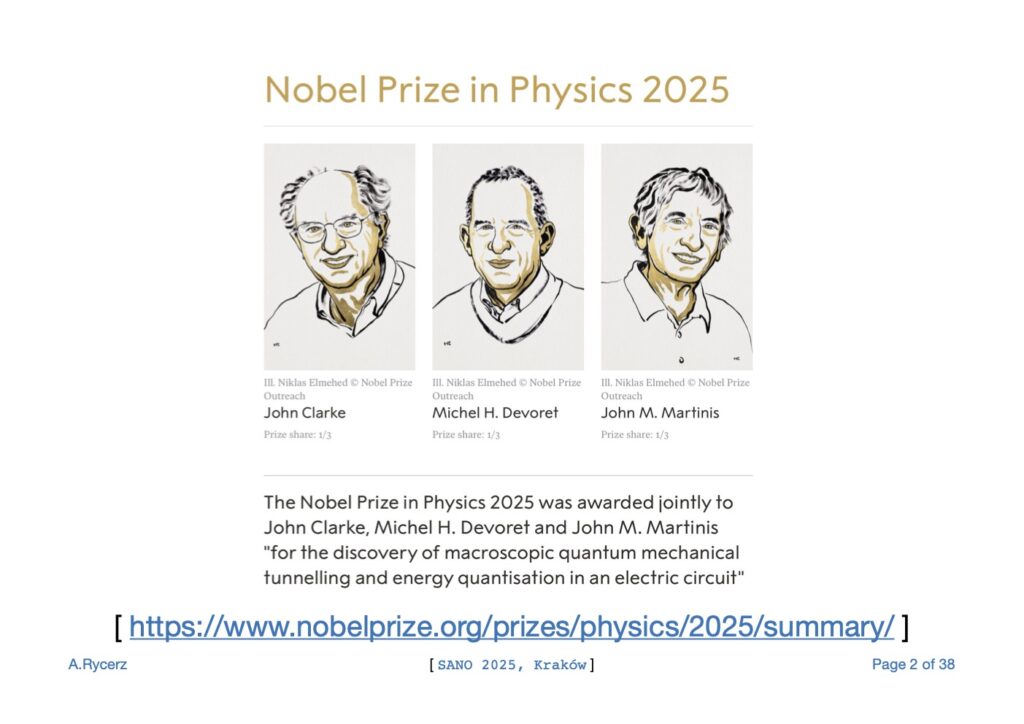
Check out Adam Rycerz’s Sano Seminars presentation: “The Nobel Prize in Physics 2025 for John Clarke, Michel H. Devoret and John Martinis – for the discovery of macroscopic quantum mechanical tunnelling and energy quantisation in an electric circuit. Click to view the full presentation.
About the author:
Professor of physics (2020), Condensed Matter Theory and Nanophysics Head (2017–present) in Institute of Theoretical Physics, Jagiellonian University. Started his adventure with theoretical physics in late 1990s from simulating random Josephson-junction network as a model for inhomogeneous superconductor. PhD thesis (2003), advised by Prof. Józef Spałek, focused on quantum states of strongly-correlated atomic chains. Postdoctoral fellow at Leiden University (2005–2006) and at Regensburg University (2007–2009). He proposed — together with J. Tworzydło and C.W.J. Beenakker — to use graphene constriction as a valley filter, the device generating nonequilibrium valley polarization in analogy to spin filter (2007); solved analytically the scattering problem for the Corbino disk in graphene for arbitrary doping and magnetic field (2010); demonstrated numerically that the electronic spectra of graphene flakes may exhibit statistical signatures of time-reversal symmetry breaking in the absence of a magnetic field (2012). He further discussed — together with G. Rut and D. Suszalski — thermoelectric properties of bilayer graphene (2018), and elaborated — by adapting the handbook kinetic theory of gases — the simplified derivation of the thermal-to-electrical conductivity ratio for massless Dirac particles violating the Wiedemann-Franz law (2021). Since 2023, his research interests focuses on many-body effects, including proximity–induced superconductivity, in nanoscale carbon systems.