

Strong Sano Representation at the Prestigious MICCAI 2025 Conference
This year’s International Conference on Medical Image Computing and Computer Assisted Intervention (MICCAI 2025) brought together leading experts in artificial intelligence, medical imaging, and computational medicine. Among them was an exceptionally strong representation from the Sano Centre for Computational Medicine — researchers from our Extreme-Scale Data and Computing team and the Medical Imaging and Robotics team — who shared their latest scientific results and took part in key sessions and workshops.
Federated Learning for Brain Tumor Segmentation
At the DeCaF Workshop on Distributed, Collaborative and Federated Learning, Jan Fiszer presented the paper “Validation of Various Normalization Methods for Brain Tumor Segmentation: Can Federated Learning Overcome This Heterogeneity?”, co-authored with Dominika Ciupek and Maciej Malawski. The full paper is available at: https://arxiv.org/abs/2510.07126.
The DeCaF workshop provided a dedicated platform for discussing methodological advances in distributed, collaborative, and federated learning approaches applied to medical data. Jan’s presentation contributed to the growing field of AI-powered collaboration in medical imaging, addressing the challenges of data heterogeneity and privacy in multi-institutional research.
Statistical Shape Analysis in Deep Vein Thrombosis
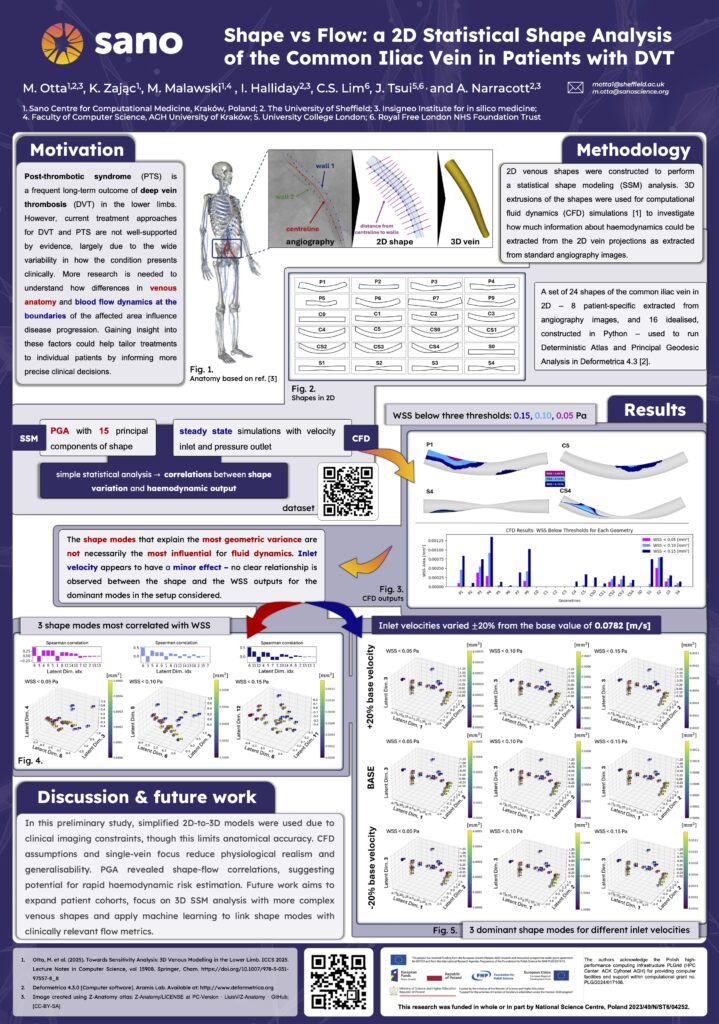
Magdalena Otta represented Sano with a poster titled “Shape vs Flow: A 2D Statistical Shape Analysis of the Projection of Common Iliac Veins in Patients with Deep Vein Thrombosis” during the Shape in Medical Imaging (ShapeMI) workshop.
The study, co-authored with Karol Zając, Maciej Malawski, Ian Halliday, Chung Lim, Janice Tsui, and Andrew Narracott, explored how geometric analysis could reveal clinically relevant differences in venous anatomy. The research offered new insights into patient-specific vascular modeling and was further detailed in a comprehensive video presentation.
The ShapeMI workshop serves as a venue for presenting state-of-the-art methods and applications in shape analysis and geometric learning in medical imaging. It brings together experts exploring how the shape and geometry of anatomical structures can be modeled, analyzed, and applied in medical contexts. With the growing availability of 3D and time-varying imaging data, the workshop emphasizes the importance of shape-based and spectral analysis as tools that offer greater sensitivity to subtle local variations than traditional structural measures.
Polish Contributions by Sano Researchers
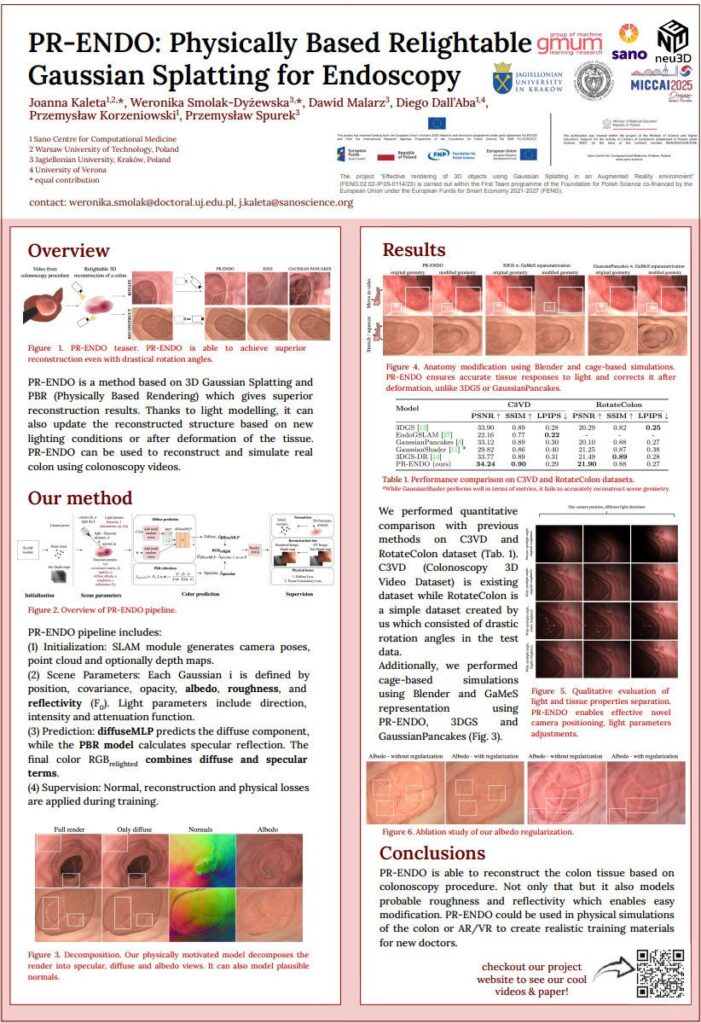
All publications from Poland presented at MICCAI 2025 listed first authors from Sano’s Extreme-Scale Data and Computing team and Medical Imaging and Robotics team — including Joanna Kaleta, Magdalena Otta, Michał Grzeszczyk, Jan Fiszer, and Tomasz Szczepański.
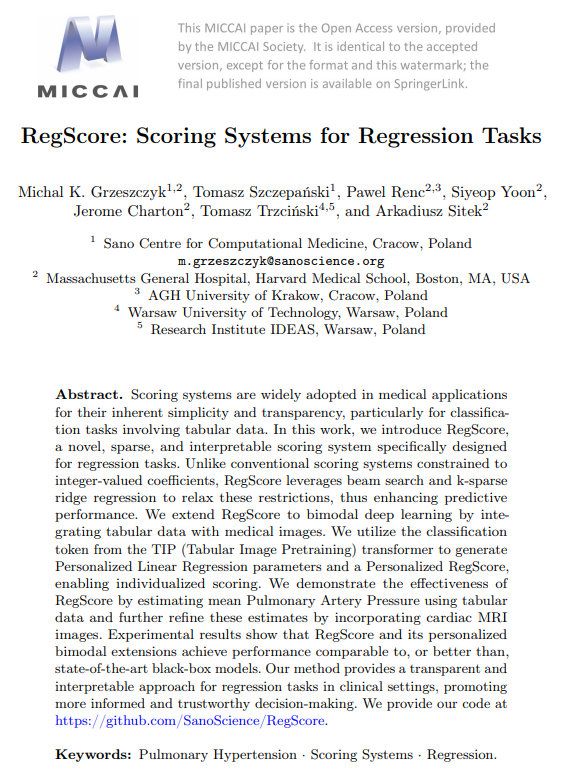
In the poster session, Michał Grzeszczyk presented his work “RegScore: Scoring Systems for Regression Tasks”, which introduced interpretable and personalized regression models combining imaging and tabular data. The paper was available on arXiv.org, with open-source code shared on GitHub.
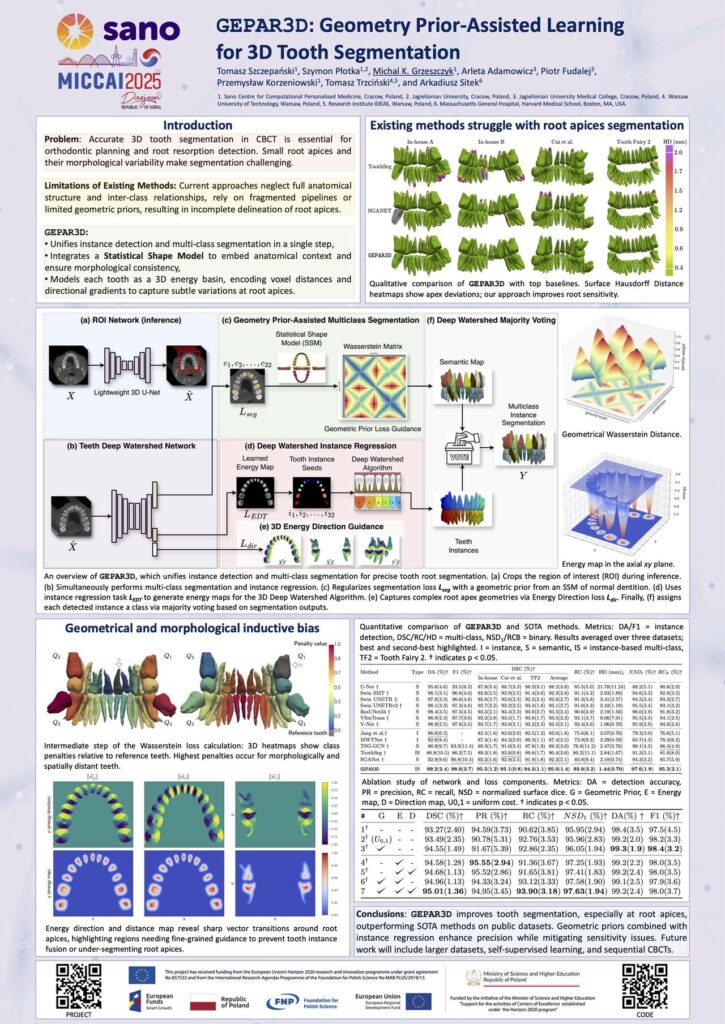
Sano’s presence was further highlighted by the poster featuring Tomasz Szczepański’s research, “GEPAR3D: Geometry Prior-Assisted Learning for 3D Tooth Segmentation”, which proposed a geometry-assisted deep learning method integrating instance detection and multiclass segmentation in dental Conical-Beam Computed Tomography CBCT scans. By integrating statistical shape priors, the method encourages anatomical consistency and substantially improves root segmentation, particularly in the apical root regions, which are critical for assessing root resorption during orthodontic treatment. The project, including code and an interactive 3D visualization demo, is available online at the project site.
Sano’s contributions were also represented by the poster presented by Joanna Kaleta — “Machine Learning-Based Decision Support for Allergy Diagnosis: Real-World Implementation in a Hospital Setting”.
Ongoing Training and Skill Development
Beyond presentations, Dominika Ciupek took part in specialized training sessions on AI bias and uncertainty analysis. Her participation underscored Sano’s commitment to continuous skill development for our scientists and to conducting responsible AI research.