
JUNCA Day 2025 – Bringing Together Researchers in Quantum and Neuromorphic Computing
The world of neuromorphic technology is evolving at an impressive pace, and JUNCA Day 2025 offered a fascinating glimpse into the future of brain-inspired artificial intelligence
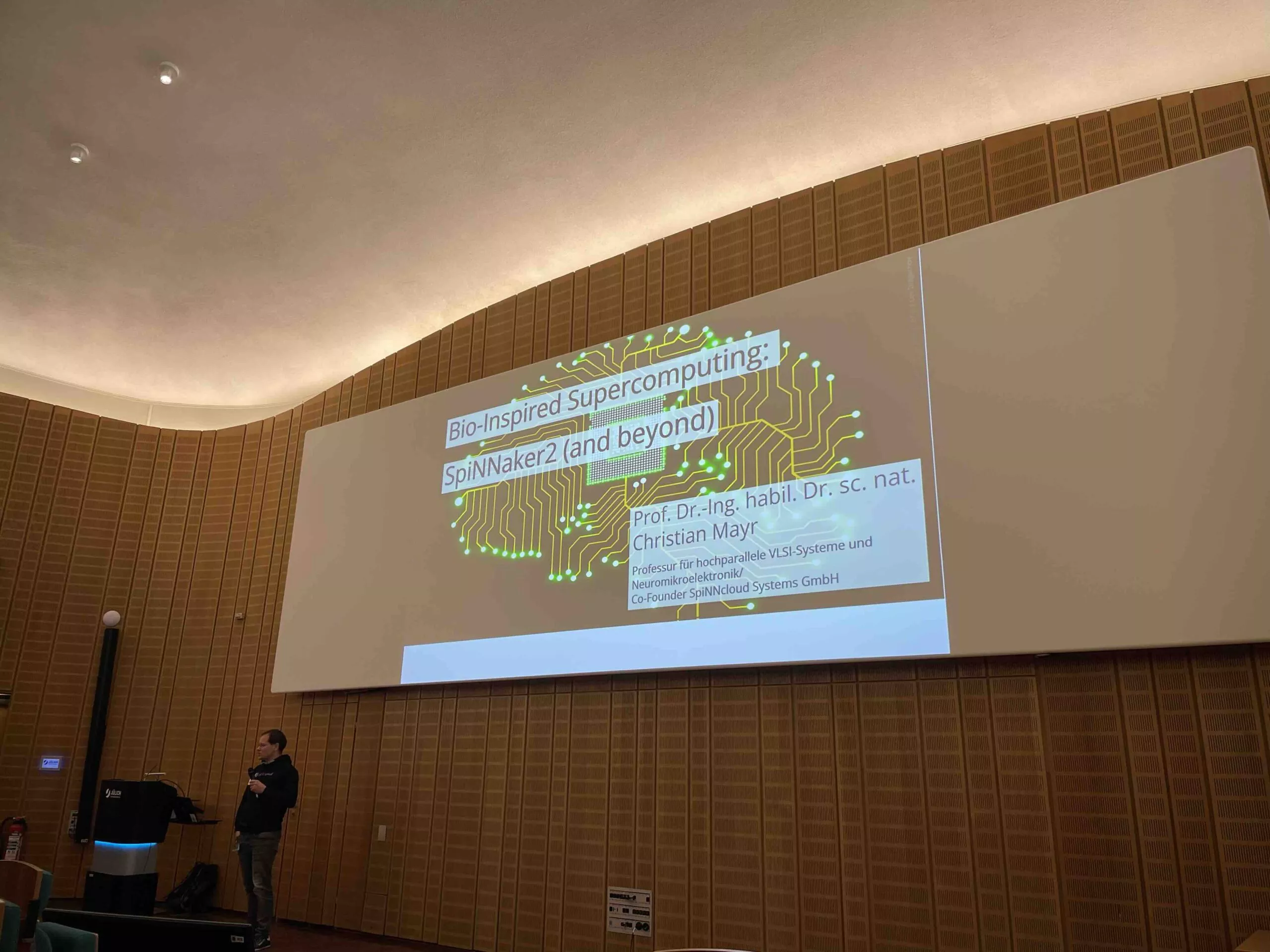
At the Central Library of Forschungszentrum Jülich, researchers, engineers, and enthusiasts came together, united by a common goal: to understand and replicate the principles of biological neural systems in modern computing architectures. Among the participants was Jan K. Argasiński, Research Team Leader of Computational Neuroscience at the Sano Centre for Computational Medicine, who shared his insights on the role of neuromorphic methods in advancing contemporary brain research technologies. This mission lies at the heart of the Jülich Neuromorphic Computing Alliance (JUNCA) – an initiative that not only fosters collaboration among scientists at Jülich but also accelerates the strategic development of neuromorphic methods and architectures.
More about JUNCA
What are neuromorphic technologies?
Neuromorphic computing technologies are inspired by the structure and functioning of the human brain. Unlike traditional computers based on a classical architecture, neuromorphic systems use artificially created “neurons” and “synapses” that process information in a highly parallel and energy-efficient manner. This approach enables the creation of systems capable of faster data analysis, learning from experience, and adapting to changing conditions. Neuromorphic systems are already finding applications in artificial intelligence, robotics, sensory systems, and big data analytics.
A rich program and inspiring speakers
The agenda of JUNCA Day 2025 was designed to maximize participant engagement and foster knowledge exchange among experts from diverse fields of neuromorphic research.
Participants then attended lectures, Poster Session showcasing and three parallel tutorial sessions, dedicated to:
• System cryogenic engineering – addressing cooling technologies and cryogenic stability,
• Quantum Error Correction – focusing on methods for error correction in quantum computations,
• Simulations / Hubbard Model – exploring simulations based on the Hubbard model.
One of the highlights was a lecture by Dr. Hendrik Bluhm (FZJ) titled “Two different scaling concepts for solid state qubits”, comparing two promising approaches to scaling solid-state quantum qubits. And keynote lecture delivered by Prof. Mikhail Lukin of Harvard University, titled “New Frontier of Quantum Computing.” The presentation included a thought-provoking idea that 95% of how humans perceive the world is shaped by imagination – a kind of cognitive “hallucination.” The comparison was drawn to artificial intelligence systems, which similarly construct their understanding of reality based on data provided during training.
The day concluded with an interactive brainstorming session, during which participants collaborated in smaller groups, exchanging ideas, and exploring concepts for joint research projects.

New perspectives for collaboration
Participation in JUQCA-Day 2025 offered an excellent opportunity to strengthen ties with our partners at Forschungszentrum Jülich and lay the groundwork for future joint research initiatives. The event clearly demonstrated how vital it is to connect disciplines – from quantum physics and computer science to neurobiology and systems engineering – to shape the computational technologies of the future.
Visit to the center of computational power
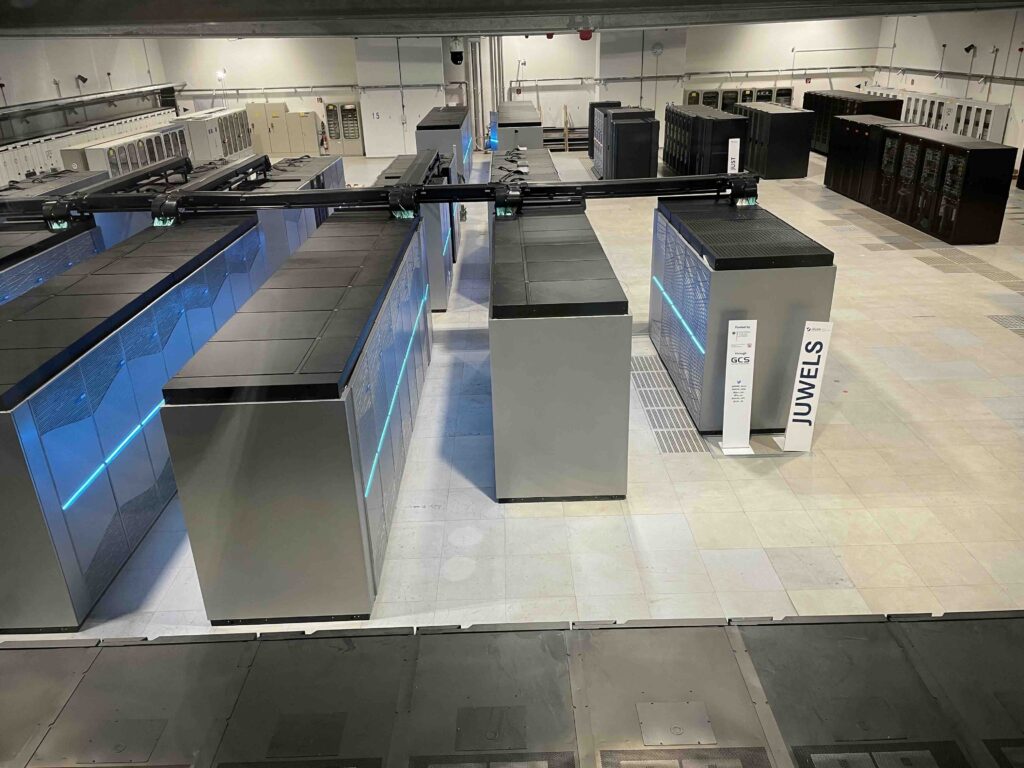
During our visit to the Jülich Supercomputing Centre, we had a unique opportunity to see the newly launched JUPITER supercomputer – currently the fastest in Europe and the fourth most powerful in the world. The FZJ experts guided us through the facility, discussing its architecture, capabilities, and the remarkable engineering effort behind its construction.
Officially inaugurated on September 5, 2025, JUPITER has since attracted significant attention from both the scientific community and policymakers. It is the first European exascale supercomputer, capable of executing over one trillion calculations per second. The system is powered by 24,000 Nvidia processors and occupies approximately 3,600 square meters.
The presentation highlighted JUPITER’s exceptional energy efficiency. Under typical workloads, it consumes around 11 megawatts, though this can rise to 20 megawatts during highly intensive operations, such as the training of large language models.
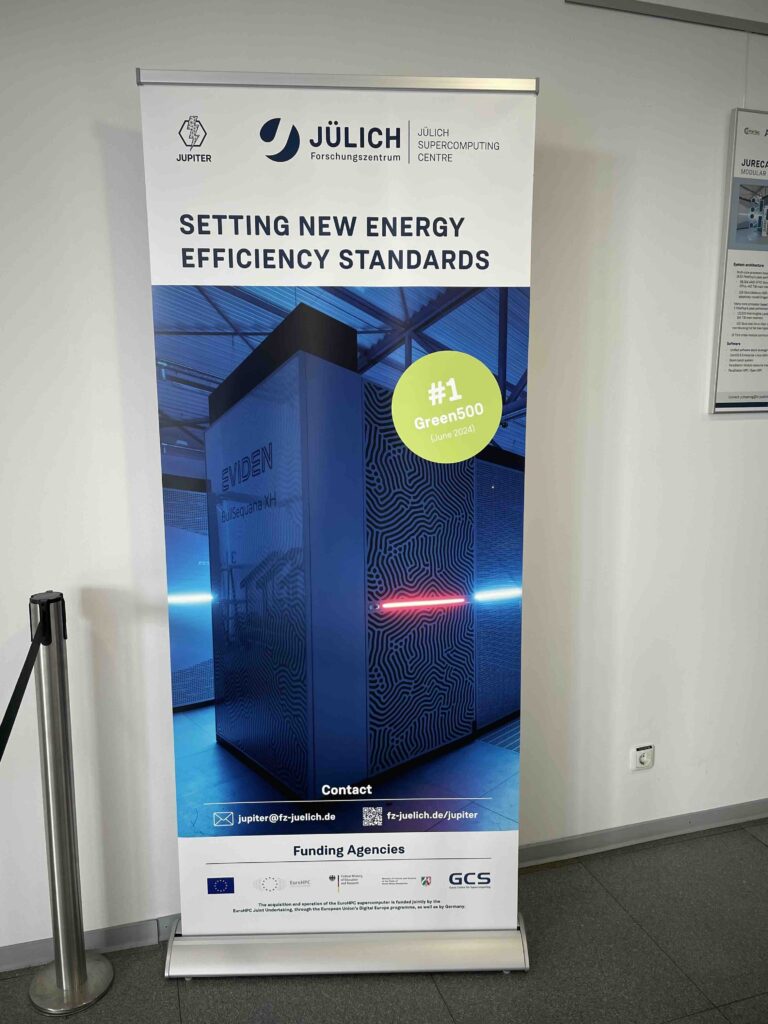
Seeing this impressive infrastructure and discussing its operation with FZJ specialists provided valuable insights into the technical and organizational challenges of the exascale computing era. JUPITER plays a central role in Europe’s high-performance computing (HPC) strategy and serves as a cornerstone for international collaboration in next-generation supercomputing research.