
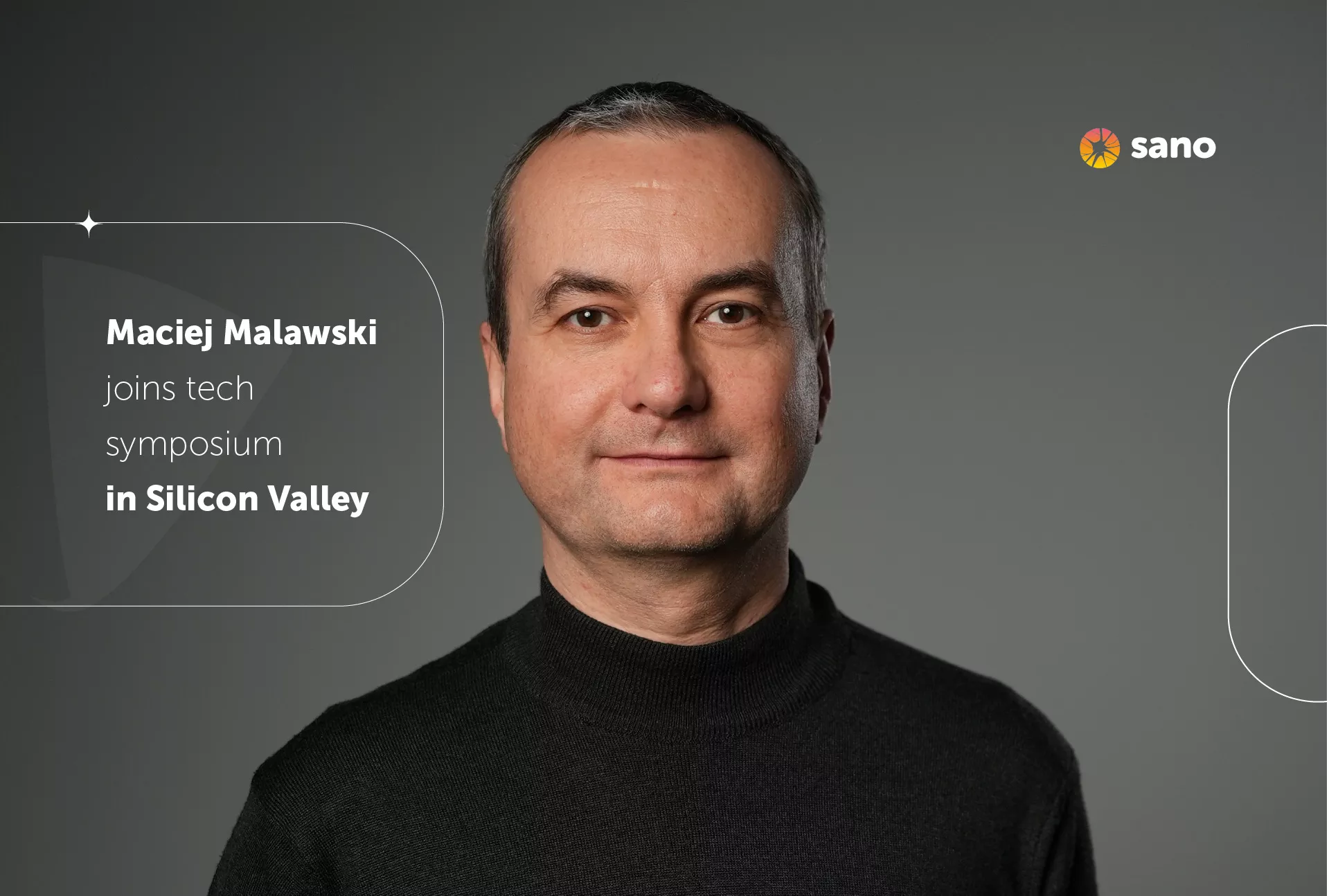
Maciej Malawski joins tech symposium in Silicon Valley
From algorithms to the orbit – US–Poland Science and Technology Symposium 2026
When medicine meets space technologies
At the beginning of June 2026, Silicon Valley will once again become a meeting point for scientists, engineers, entrepreneurs, and policymakers from Poland and the United States. Among them will be Maciej Malawski the director of the Sano Centre for Computational Medicine, taking part in the US–Poland Science and Technology Symposium—a long-running event focused on turning scientific ideas into real-world innovation. During the third day of the conference, dedicated to the theme “BioSpace, Health & Cross-Sector Innovation,” he will speak as a panelist in a session titled “Healthcare, Industry & Public Services”, bringing a computational perspective to one of the most demanding areas of modern medicine.
Organized by the US–Poland Trade Council in collaboration with the Polish Silicon Valley Accelerator, the event has spent over 25 years fostering durable partnerships and accelerating knowledge transfer between Poland and the United States. Over that time, it has grown into a platform where strategic discussions naturally turn into concrete projects, joint ventures, and research collaborations.
Although the theme of this year’s edition is “Opportunities in Aviation and Space,” the conversation goes far beyond rockets and aircraft. Today, fields like aerospace, medicine, and artificial intelligence are increasingly connected through shared technological challenges: processing vast amounts of data, running complex simulations, and designing systems that can scale.
Aviation and space industries are entering a phase of rapid change, shaped by AI, new materials, and growing global competition. The same computational tools used to model biological systems or optimize healthcare processes can also support spacecraft design or air traffic systems. This is where experts like Maciej Malawski come in. His work in distributed computing and workflow management shows how advanced computing can bridge disciplines—linking, for example, medical simulations with large-scale engineering problems.
A three-day exchange of ideas
The symposium, hosted across Stanford, UC Berkeley, and UCSF, is designed as an intensive, hands-on experience rather than a traditional conference. Participants will explore and engage in:
- Thematic workshops on building international R&D consortia
- Sessions on intellectual property in dual-use environments
- Guidance on preparing globally competitive grant proposals
- Curated business meetings connecting innovators with investors and institutional partners
Together, these activities create an environment where collaborations can move quickly from concept to implementation.
The goal is simple: move from ideas to partnerships as quickly as possible.
More than networking: building real collaborations
For Sano, participating in this kind of event is about staying connected to a rapidly evolving global ecosystem. Computational medicine does not exist in isolation—it depends on advances in computing, data science, and engineering that are often driven by other sectors. By engaging with experts in aviation, space, and advanced technologies, Sano gains new perspectives and opportunities to apply its research in unexpected ways.
One conversation, many directions
Events like the US–Poland Science and Technology Symposium show how boundaries between disciplines are becoming less important. Whether the problem involves human health or space exploration, the underlying questions are often similar: how to model complexity, how to process data efficiently, and how to turn knowledge into practical solutions. As aviation and space industries enter a new era of commercialization, the demand for advanced computational tools is growing rapidly. By sharing its expertise in this discussion, Sano strengthens its role as an active player in shaping the wider technological landscape. Maciej Malawski’s participation also illustrates a broader shift: science is no longer confined to narrow disciplines, and the most intriguing breakthroughs often arise where different fields intersect.
More information