
Maciej Malawski at the US–Poland Science and Technology Symposium 2026
Computational Medicine Meets Aviation and Space
What was announced in advance became a concrete presence on the ground in Silicon Valley: Maciej Malawski, Director of the Sano Centre for Computational Medicine, took part in the US–Poland Science and Technology Symposium 2026, held on June 1–3 across Stanford University, UC Berkeley and UCSF. The 2026 edition focused on “Opportunities in Aviation and Space” and brought together researchers, innovators, entrepreneurs and policymakers from Poland and the United States around cross-sector collaboration and commercialization.
For Sano, participation in the symposium was a natural continuation of the themes highlighted in the earlier announcement: the growing connection between computational medicine, advanced computing, artificial intelligence and other technology-driven sectors. This broader context is especially relevant at a time when data-intensive tools, simulation methods and scalable computing infrastructures are increasingly shared across healthcare, engineering and public-sector innovation.
On the third day of the symposium, dedicated to “BioSpace, Health & Cross-Sector Innovation” at UCSF, Maciej Malawski joined the panel “Healthcare, Industry & Public Services,” contributing Sano’s perspective to a discussion on how computational approaches can support complex health challenges in a wider innovation ecosystem. His participation aligned closely with his research background in parallel and distributed computing, high-performance computing, cloud technologies and workflow management, areas that are central to Sano’s work in computational medicine.
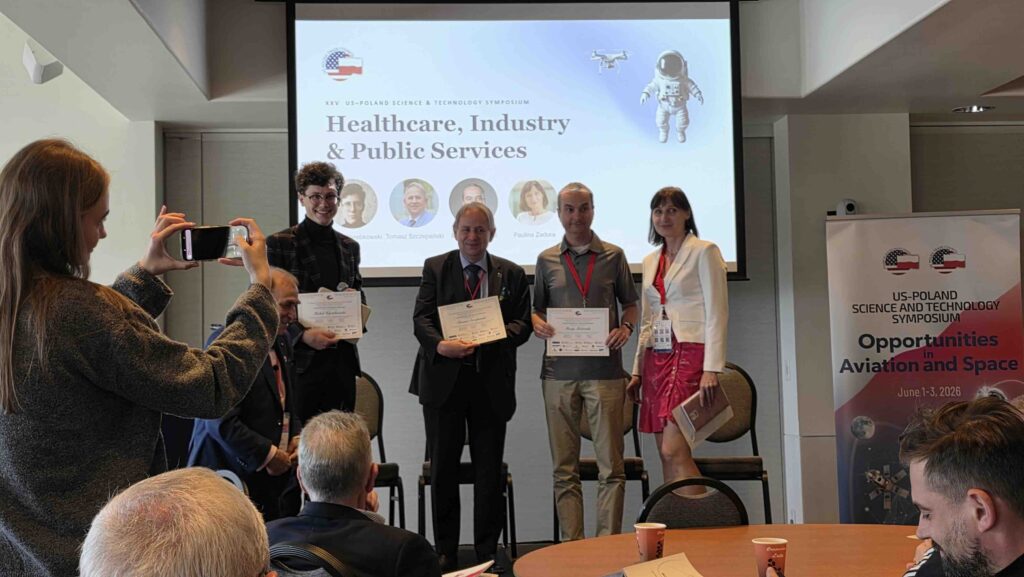
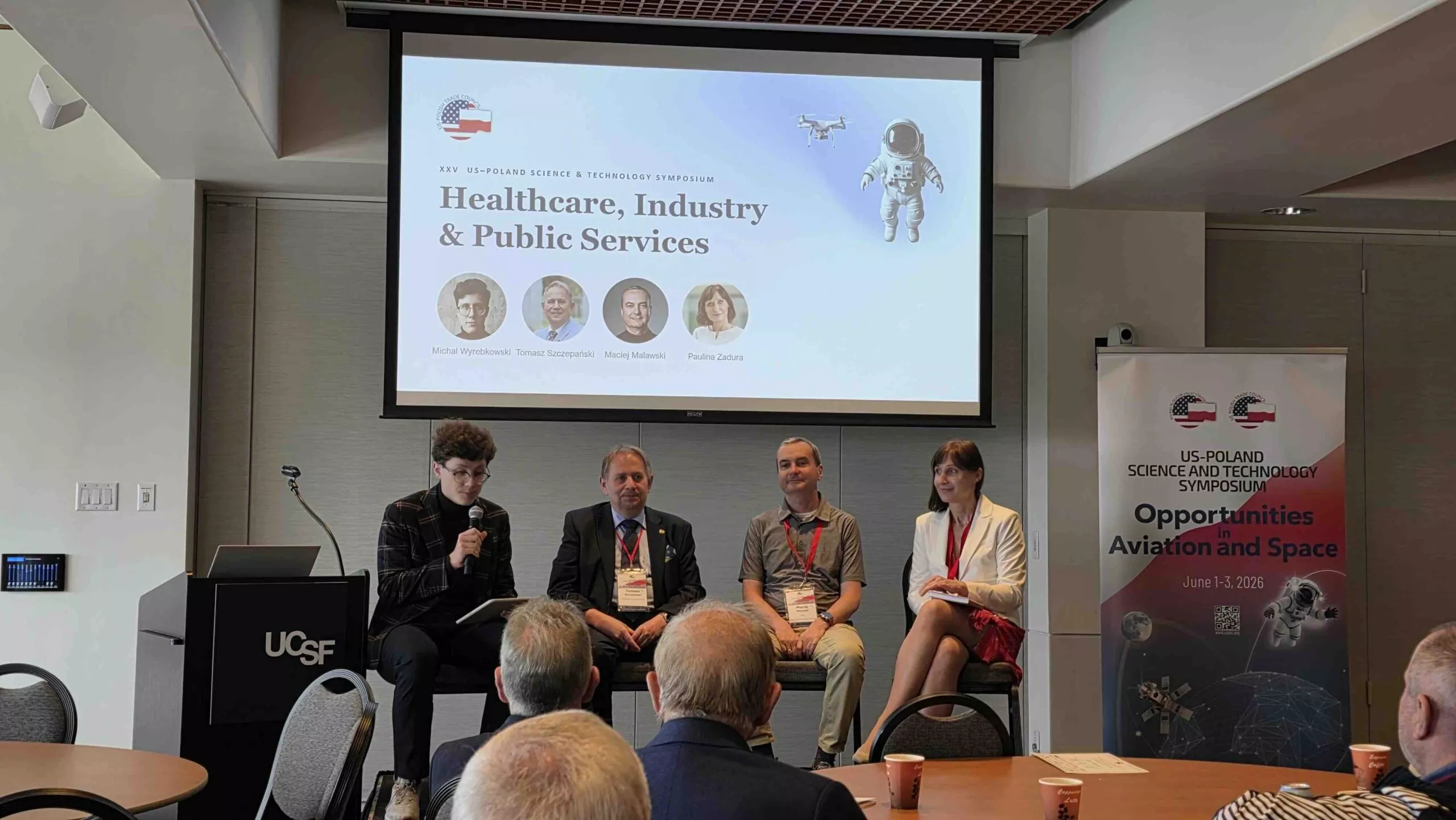
During the “Healthcare, Industry & Public Services” panel at the US–Poland Science and Technology Symposium 2026. From left: Michal Wyrebkowski, Tomasz Szczepański, Maciej Malawski and Paulina Zadura.
The panel photo captures this moment particularly well, showing Maciej Malawski in conversation with fellow panelists Michal Wyrebkowski, Tomasz Szczepański and Paulina Zadura. Framed within a session dedicated to healthcare, industry and public services, the discussion reflected exactly the kind of interdisciplinary setting in which Sano’s expertise becomes especially meaningful: one where medical innovation is discussed not in isolation, but alongside broader technological, institutional and implementation challenges.
The symposium itself is designed as more than a conventional conference. Organizers present it as a platform where science meets commercialization across the US–Poland innovation ecosystem, with a strong emphasis on partnerships, practical workshops and exchanges that can lead to future joint initiatives. In that setting, Sano’s presence helped reinforce the Centre’s visibility as a research organization working at the intersection of medicine, computation and translational innovation.
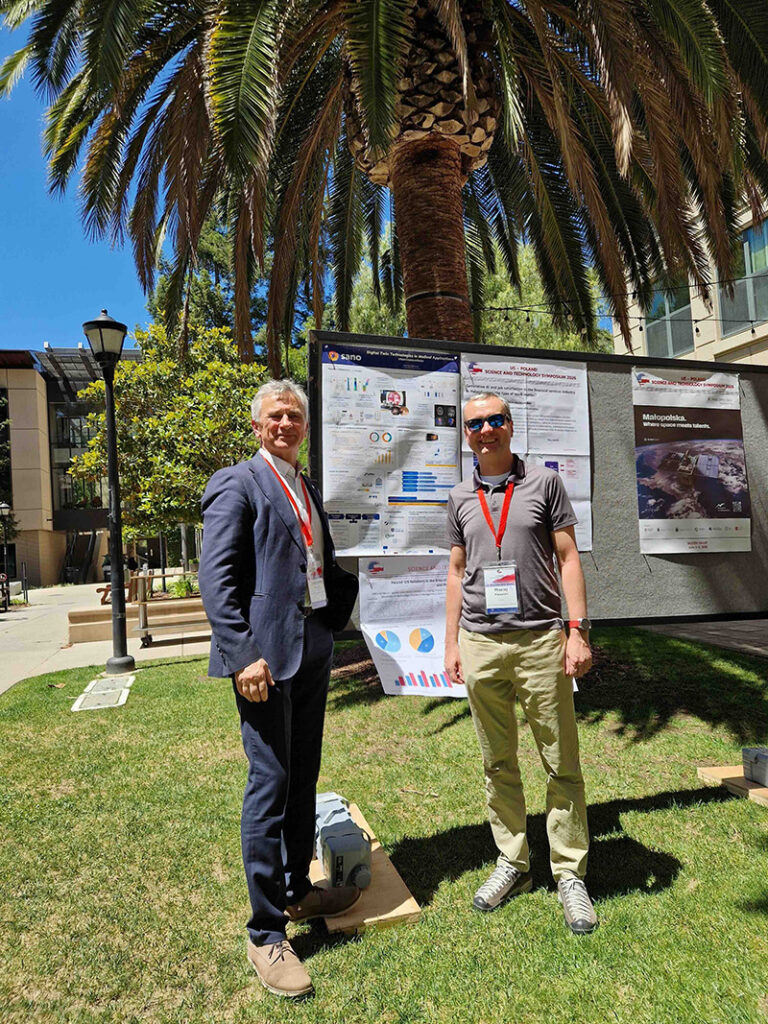
Beyond the panel session, the event also created space for direct conversations around research topics and technologies relevant to Sano’s mission. One of the photos from the poster session shows Kazimierz Murzyn and Maciej Malawski standing by a Sano poster, underlining the role of the symposium not only as a forum for discussion, but also as a place for presenting concrete research directions and engaging with participants in a more focused format.
Taken together, the panel participation and poster-session presence show Sano contributing to the symposium on two complementary levels: through strategic discussion and through research communication. This combination reflects the Centre’s broader role in international collaboration, where scientific expertise, computational methods and institutional partnerships come together to support the future of medicine and technology.