
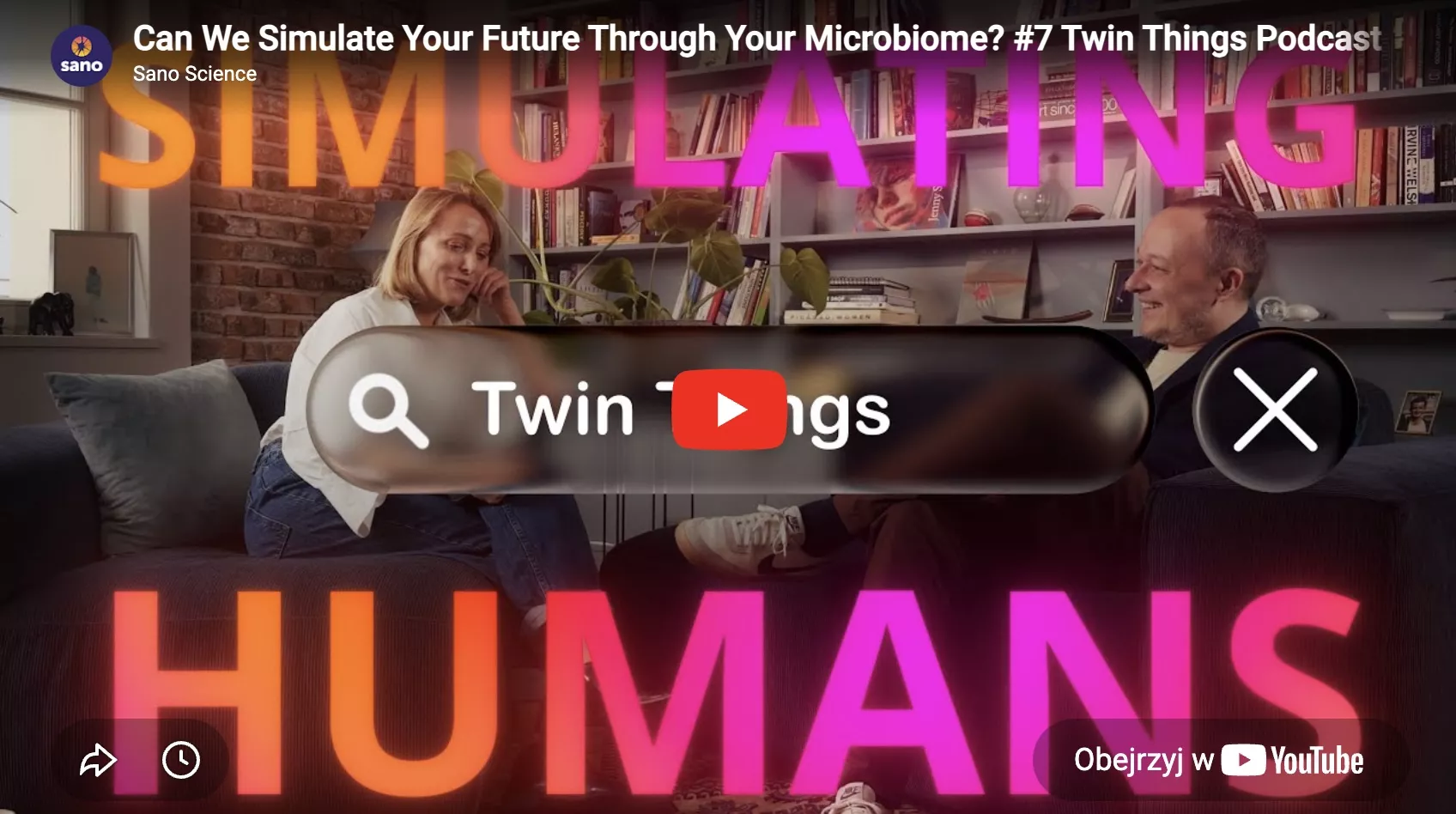
Can We Simulate Your Future Through Your Microbiome?
Twin Things Podcast #7 – a conversation with Tomasz Kościółek from Sano
Microbiome AI digital twins
What if the microbes living inside us could offer a preview of our future health? This is the starting point for episode #7 of the Twin Things Podcast, in which host Kasia Baliga‑Nicholson talks to Tomasz Kościółek, Research Team Leader of the Structural and Functional Genomics Group at Sano Centre for Computational Medicine.
If you’re curious how tiny organisms and big data come together in computational medicine, follow the link and watch the full discussion.
nstead of treating the microbiome as just a “background detail”, the conversation looks at it as a dynamic layer of the human body – one that continuously interacts with our diet, environment, and physiology. Tomasz explains how computational biology and AI are changing the way researchers work with microbiome data: from studying individual bacterial strains to analysing complex networks of interactions and their potential links to health and disease.
Across the episode, Kasia and Tomasz move between concrete laboratory questions and broader ideas about modelling the human body. This podcast episode on microbiomes, AI and microbiome AI digital twins also touches on gut bacteria and protein structures, tools such as AlphaFold, the role of data standards, as well as citizen science initiatives that invite non‑experts into microbiome research. The notion of “digital twins” – virtual models of a person that can be updated with real data over time – appears as one of the ways in which future healthcare might integrate microbiome information into personalised decision‑making.
Why microbiome AI digital twins matter for future health
Rather than promising simple answers, the discussion highlights both the opportunities and the limitations of trying to “simulate” possible health trajectories. It offers a clear, accessible entry point into current microbiome science, while showing how computational tools and AI can help connect microscopic organisms with questions about prevention, diagnosis, and long‑term wellbeing.