
LumiMotion: when scene motion improves light
– Joanna Kaleta’s CVPR 2026 highlight
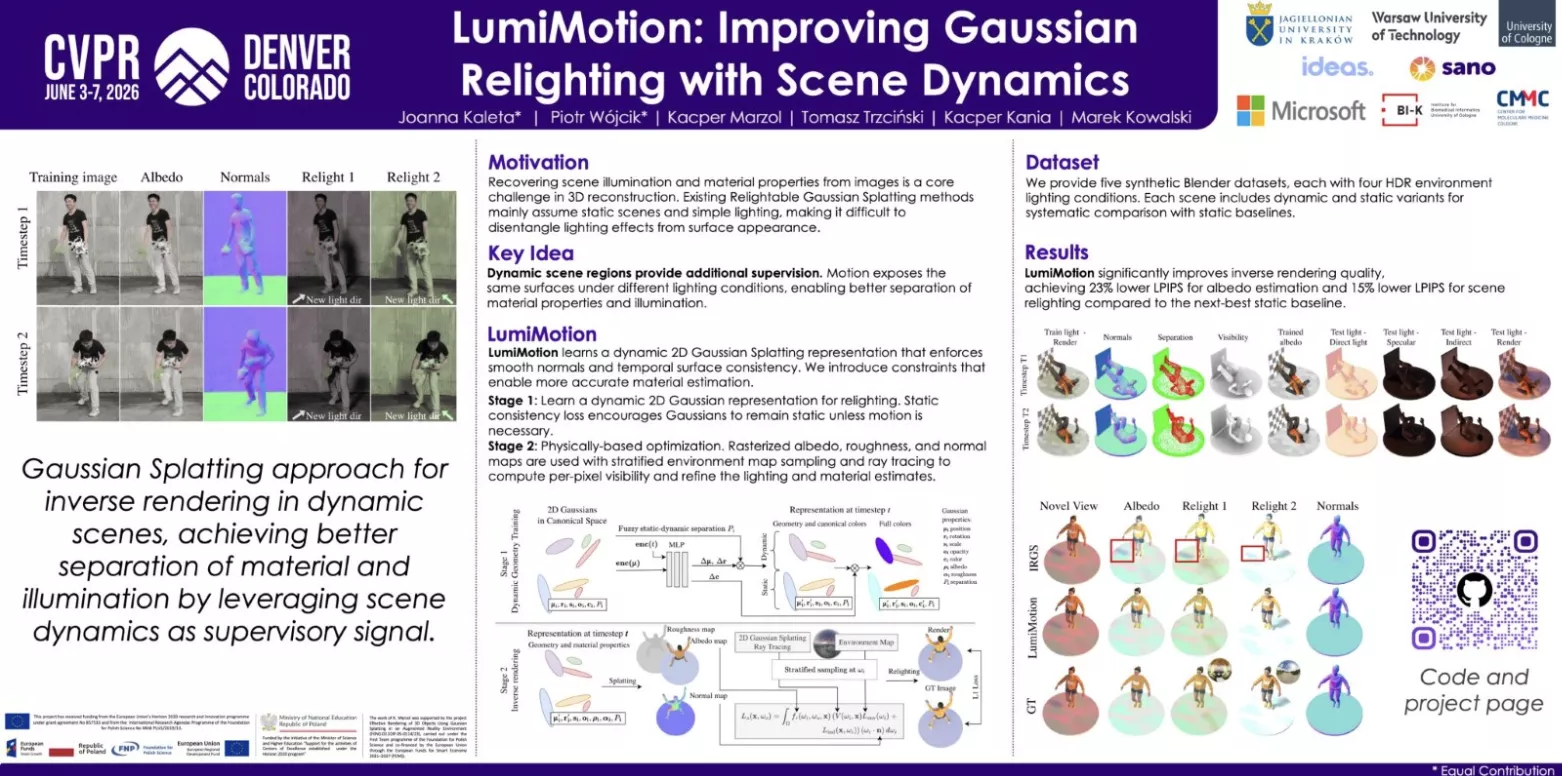
At the Conference on Computer Vision and Pattern Recognition (CVPR) 2026 in Denver, Joanna Kaleta presented the highlighted poster “LumiMotion: Improving Gaussian Relighting with Scene Dynamics”, co‑authored with Piotr Wójcik, Kacper Marzol, Tomasz Trzciński, Kacper Kania and Marek Kowalski, showing how scene dynamics can serve as an additional supervisory signal to achieve more physically grounded, flexible and realistic lighting in relighting pipelines based on 3D Gaussian Splatting – a technology increasingly used in computer graphics and mixed reality.
CVPR is one of the world’s leading conferences in computer vision and machine learning, and in 2026 it took place on 3–7 June in Denver, Colorado, with highlighted papers and posters representing a small fraction of accepted works that the community regards as particularly influential for the future of the field.
What is LumiMotion?
LumiMotion is a two‑stage inverse rendering framework whose goal is to disentangle object geometry and material from scene illumination so that lighting conditions can be realistically changed afterwards. The key idea is to treat motion as a supervisory signal that reveals the same surfaces under different lighting, helping the model understand which image variations belong to static scene structure and which are caused by changing illumination.
In practice, LumiMotion improves relighting quality in dynamic scenes where traditional 3D Gaussian Splatting methods designed for static setups start to struggle, especially under complex lighting. By explicitly exploiting motion, the method achieves more consistent colors, better material appearance and more stable shadows when the direction or spectrum of light is modified.
LumiMotion is rooted in computer graphics and computer vision and its core challenge — reconstructing 3D scenes while disentangling illumination from the underlying appearance of surfaces — is highly relevant to computational medicine. This is especially important in medical imaging settings such as endoscopy, where the light source is co-located with the camera and strongly shapes what the sensor observes. Methods that make lighting more realistic, controllable, and separable from tissue appearance can support more reliable medical 3D reconstruction, more robust synthetic data generation for AI models, and better simulation and visualisation tools for training, planning, and education.
Joanna Kaleta’s CVPR 2026 poster, developed together with Piotr Wójcik, Kacper Marzol, Tomasz Trzciński, Kacper Kania and Marek Kowalski, illustrates how work at the intersection of academia and Sano can simultaneously advance core computer vision methods and lay technical foundations for future applications in digital health.