Sano at VPH 2026
from patient models to trust in digital twins
Eleven presentations, two posters, two chaired sessions and a hands-on cardiovascular simulator: a look back at Sano’s presence at VPH 2026 in Milan.
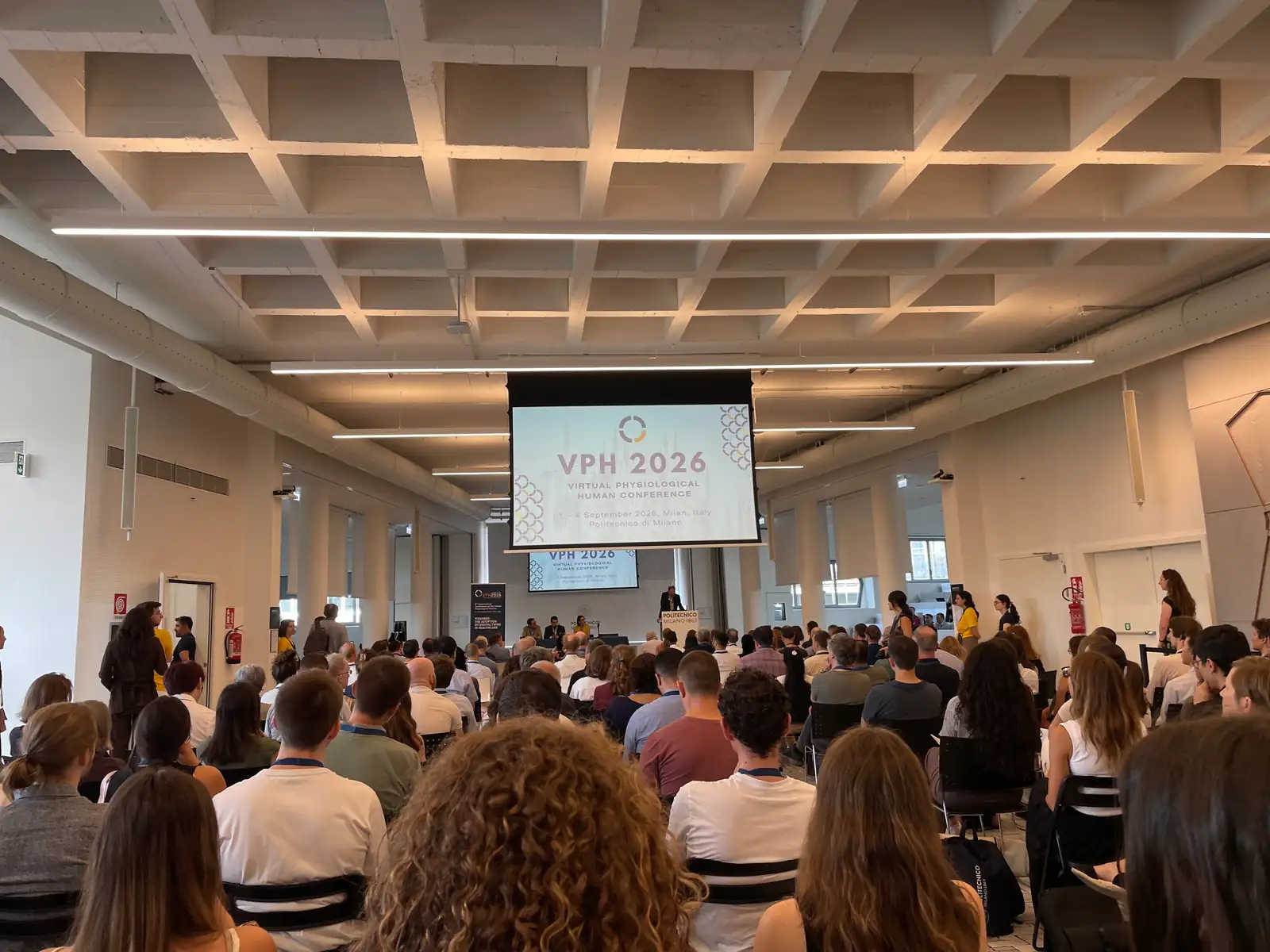
More than 650 experts, researchers, clinicians, engineers, and students from around the world gathered in Milan for VPH 2026, a conference dedicated to the future of in silico medicine and the adoption of digital twins in healthcare. Representatives of Sano actively contributed to the event, presenting research findings, sharing their expertise, helping shape the scientific programme, and welcoming visitors at the Sano stand.

The conference was organised by VPH – The Society for In Silico Medicine in collaboration with Politecnico di Milano. This year’s theme, “Towards the Adoption of Digital Twins in Healthcare”, highlighted the growing importance of computational modelling and digital twin technologies in medicine.
The programme covered a broad range of topics, including computational modelling, in silico medicine, the credibility and regulation of digital twins, clinical decision support, in silico oncology, multi-omics, and the ethics of trustworthy artificial intelligence.
Sano Research on the International Scientific Stage
Sano representatives presented research exploring a wide range of applications of computational methods and artificial intelligence in medicine. Their contributions demonstrated how advanced modelling, data analysis, and digital twin approaches can support the development of more personalised, safe, and reliable healthcare.
The research presented included the following contributions:
Oral presentations
Wednesday, 2 September
- “From Data to Diagnosis: A Hospital Proof of Concept of AI-Driven Allergy Diagnostics” – P. Tworek, M. Szczypka, M. Mikołajczyk, R. Lewandowski, J. Sousa. A first test, in a hospital setting, of AI that supports allergy diagnosis.
- “Twin Models of Survival in Patients with Glioblastoma Using Normative Neuroimaging” – A. Janus, J. Falcó-Roget, B. Wojtarowicz, J. Rybska, C. di Paola, A. Ielo, S. Lillo, L. S. Politi, J. K. Argasiński, A. Cacciola. Patient models that compare brain scans with typical, healthy brains to study survival in glioblastoma, an aggressive brain tumour.
Thursday, 3 September
- “Machine-Learning-Supported Personalisation of a Zero-Dimensional Cardiovascular Model with Baroreflex” – K. Tlałka, I. Halliday, A. Narracott, M. Malawski. Using machine learning to tailor a simplified model of blood circulation – including the reflex that keeps blood pressure stable – to an individual.
- “Neuroanatomy Atlas as a Core for Virtual Brain Twin: Sharing Three-Decade-Long Experience” – W. Nowinski. Three decades of brain-atlas work as a foundation for virtual brain twins.
- “Uncertainty and Sensitivity in Venous Modelling Across 0D, 3D and Statistical Shape Frameworks” – M. Otta, K. Zając, I. Halliday, C. Lim, J. Tsui, M. Malawski, A. Narracott. How confident we can be in models of veins built in different ways, and which inputs matter most.
Friday, 4 September
- “fMRI-Derived Oculomotor Signatures Predict Visual Recovery Trajectories After Stroke” – J. K. Argasiński, M. Turczyniak, C. Koba. Using brain-scan patterns linked to eye movements to predict how vision recovers after a stroke.
- “LLM-Based Psychological Digital Twins in Social Research: Application to Anti-Vaccination Movements” – P. Sobkowicz. Large language models used as psychological digital twins in social research, applied to anti-vaccination movements.
- “Comparison of Uncertainty Quantification Methods for Aneurysm Hemodynamics” – D. Miklós, K. Zając, L. Sándor, B. Csippa, G. Paál. Comparing ways to measure how reliable simulations of blood flow in aneurysms (bulges in an artery wall) are.


Short presentations
- “An Uncertainty-Aware Framework for Safe EEG-Based Stroke Triage” (2 September) – R. Blanco, M. N. van Stigt, E. A. Groenendijk, J. K. Argasiński, J. M. Coutinho, A. Lisowska, H. A. Marquering. A method that uses EEG (recordings of the brain’s electrical activity) to help sort stroke patients, while showing how certain each result is.
- “From Standards to Practice: Scalable Credibility Assessment of Virtual Physiological Human Models” (3 September) – K. Zając, M. Kasztelnik, P. Połeć, P. Nowakowski. A way to check, at scale, whether computer models of the human body meet credibility standards – in other words, whether they are fit for their intended use.
Posters
- “An Uncertainty-Aware Framework for Safe EEG-Based Stroke Triage” – presented by Rosmary Blanco (2 September).
- “From Standards to Practice: Scalable Credibility Assessment of Virtual Physiological Human Models” – presented by Karol Zając (3 September).
Session chairs
On Friday, 4 September, two Sano researchers chaired parallel sessions:
- Marian Bubak – credibility assessment, verification and validation of digital twins.
- Maciej Malawski – systems biology and multi-scale modelling.
From credibility to trust
Credibility was also the focus of one of the conference’s plenary moments: the roundtable “From Credibility to Trust” on 3 September, moderated by Prof. Liesbet Geris. Its panellists – Natalia Trayanova, Vincenzo Carbone, Finn Catling, Zita Van Horenbeeck, Sara Bridio and Steven Bourke – brought perspectives from academia, industry, clinical practice, regulatory science, social science and patient advocacy, and discussed why a technically credible model is not automatically a trusted one.
The panel provided a forum for exchanging perspectives and reflecting on the challenges facing the scientific and medical communities. Discussions of this kind are particularly important as the field moves from advanced computational models and research prototypes towards solutions that can be reliably used in clinical practice.
Recognising Outstanding Early-Career Researchers
VPH 2026 also celebrated the achievements of emerging researchers making significant contributions to the field of in silico medicine. Prestigious awards were presented to outstanding early-career researchers in three categories:
- VPH Best Thesis Award – recognising outstanding achievements in theses and research.
- VPH Best Poster Award – recognising an outstanding scientific poster presentation.
- ESTIV Best Abstract Award – recognising an outstanding scientific abstract.
These awards highlight the importance of supporting the next generation of researchers and creating opportunities for new ideas, interdisciplinary approaches, and innovative methods to be presented and developed on the international stage.
Meet Sano: Our Stand at VPH 2026
Throughout the conference, the Sano stand was a meeting point for everyone interested in our work. Visitors were invited to try our high-fidelity cardiovascular simulator (https://sano.science/wp-content/uploads/2026/06/CARDIOVASCULAR-SIMULATOR.pdf) in a mini angiography training session: guiding a thin tube called a catheter through the heart’s blood vessels, as doctors do during coronary catheterisation.
At the stand, we also presented other solutions developed at Sano, as well as our research interests and activities. Visitors could meet members of our communication and PR team, several team leaders, researchers and Sano’s directors, and talk with them about our work and about opportunities for collaboration.
We also used the occasion to talk about the upcoming Krakow Conference on Computational Medicine (KCCM 2027), which Sano is co-organising. The conference will take place in Kraków on 22–25 June 2027, under the theme “Towards digital twins in virtual human twin environment”.


Working Together to Advance Digital Twins in Healthcare
VPH 2026 demonstrated that the development of digital twins for healthcare requires collaboration across multiple disciplines, from computer science, engineering, and applied mathematics to biomedical research and clinical practice. Equally important are model credibility, appropriate evaluation standards, methodological transparency, and the responsible use of artificial intelligence.

The active participation of Sano representatives – including oral and poster presentations, session chairing, the Sano stand, and engagement in scientific discussions – contributed to this international exchange. The conference provided an opportunity to showcase ongoing research, establish connections, and explore future directions for computational methods that can support medicine.
The meeting in Milan reinforced the idea that the wider adoption of digital twins in healthcare depends on combining technological innovation with rigorous scientific research and close collaboration between academic and clinical communities.