
Can AI Treat People? Reflections from the Copernican Debate in Olsztyn
During a public debate in Kortosfera, Sano’s Maciej Malawski joined clinicians to discuss how far we can trust AI in medicine and where humans must stay in control.
During a public debate in Kortosfera, Sano’s Maciej Malawski joined clinicians to discuss how far we can trust AI in medicine and where humans must stay in control.
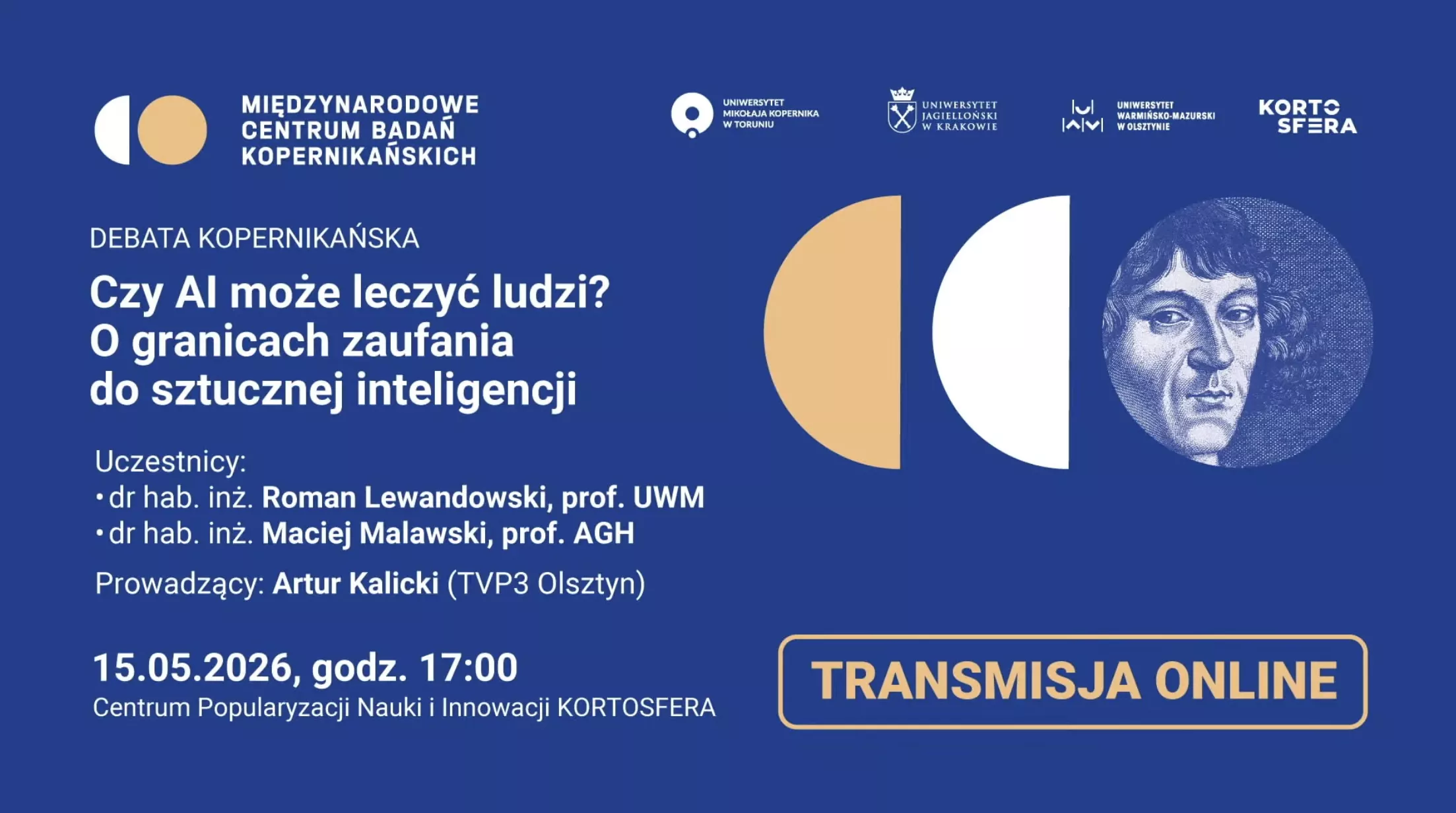
On 15 May, the International Centre for Copernican Research hosted the seventh Copernican Debate in Kortosfera, titled “Can AI treat people? On the limits of trust in artificial intelligence”. The discussion explored how algorithms already support diagnosis, therapy and hospital workflows, and asked who should have the final say in clinical decisions – the doctor or the model running in the background.
The main guests were Dr hab. inż. Roman Lewandowski, director of the Regional Rehabilitation Hospital for Children in Ameryka, and Dr hab. inż. Maciej Malawski, Prof. AGH and researcher at Sano – Centre for Computational Personalised Medicine. Together they work on AI‑based methods to support allergy diagnosis and treatment in children, showing how collaboration between hospitals and computational scientists can move digital tools from theory to bedside.
Speakers stressed that AI is already embedded in areas such as CT, MRI and EEG analysis, where algorithms detect subtle patterns and act as a “second pair of eyes”, but responsibility for decisions remains with physicians. They highlighted that doctors who use AI safely can be more effective, especially if systems take over repetitive administrative work and free time for direct contact with patients. An example from the hospital in Ameryka is automatic note‑taking, where AI generates structured visit summaries after listening to doctor–patient conversations.
A key part of the debate focused on trust, data quality and bias. The panellists reminded the audience that models are only as good as the data they are trained on and may perform poorly for under‑represented groups or populations. This is why they argued for building Polish and European datasets and infrastructure, instead of relying solely on global, freely available tools trained on unverified internet data that can confuse diseases, drugs or medical specialties.
The discussion also touched on AI‑supported triage and resource management, where algorithms can help prioritise queues and assign patients to specialists based on clinical parameters. At the same time, fully autonomous robotic procedures without a human operator were met with scepticism, reflecting society’s current reluctance to hand over high‑risk interventions entirely to machines.
For Sano, Prof. Malawski’s presence in the Copernican Debate is part of a broader effort to bring computational medicine into public dialogue and to ensure that new AI tools in healthcare are shaped not only by technical possibilities, but also by clinical reality and societal expectations. The full recording of “Can AI treat people? On the limits of trust in artificial intelligence” is available on the YouTube channel of the University of Warmia and Mazury.