
Teaching AI to fill in the gaps
At the Health AI & CyberSec Summit in Warsaw, Sano’s Wojciech Szymański showed how to make 3D medical image reconstruction more robust — and introduced Defect API, a way to train models without hand-labelled data.
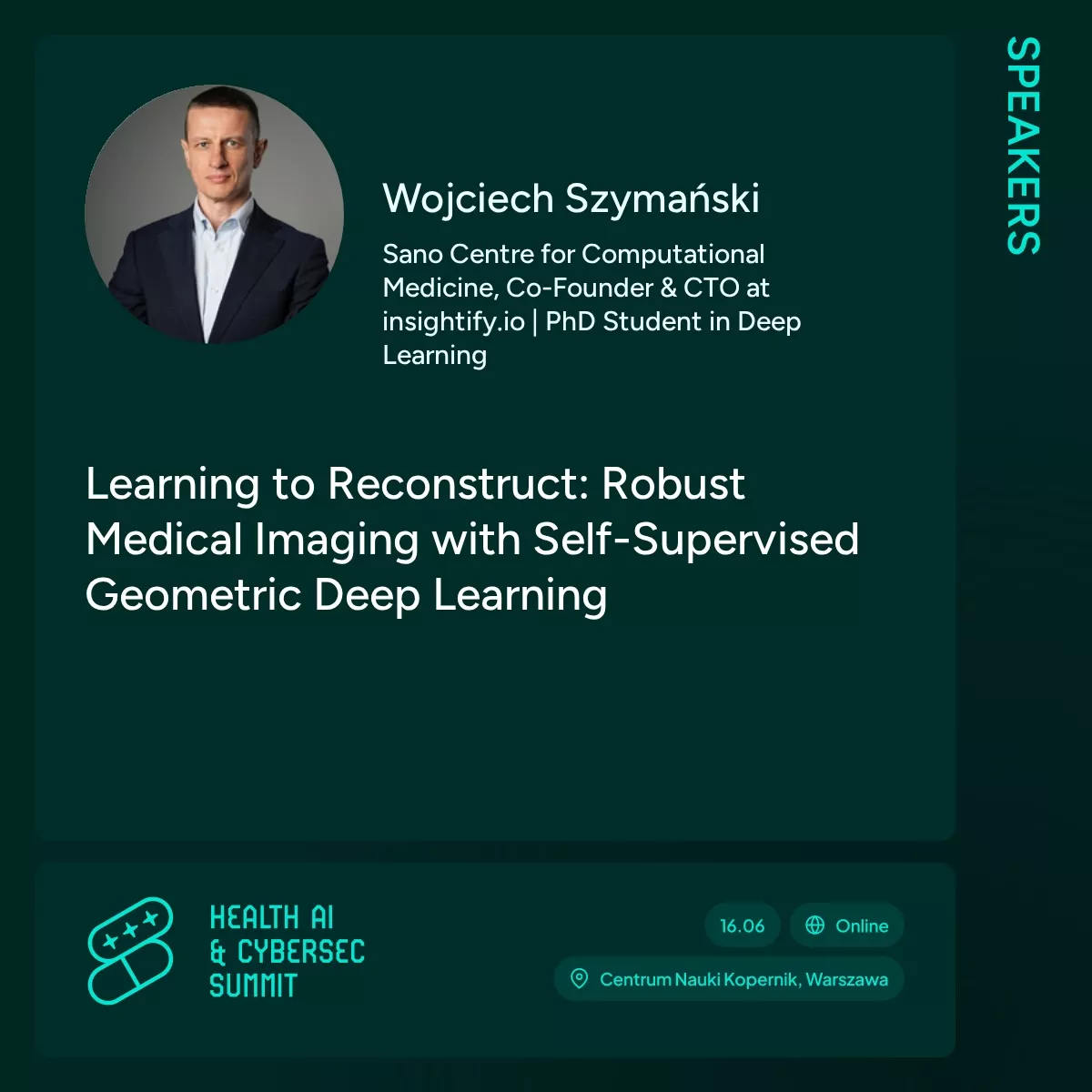
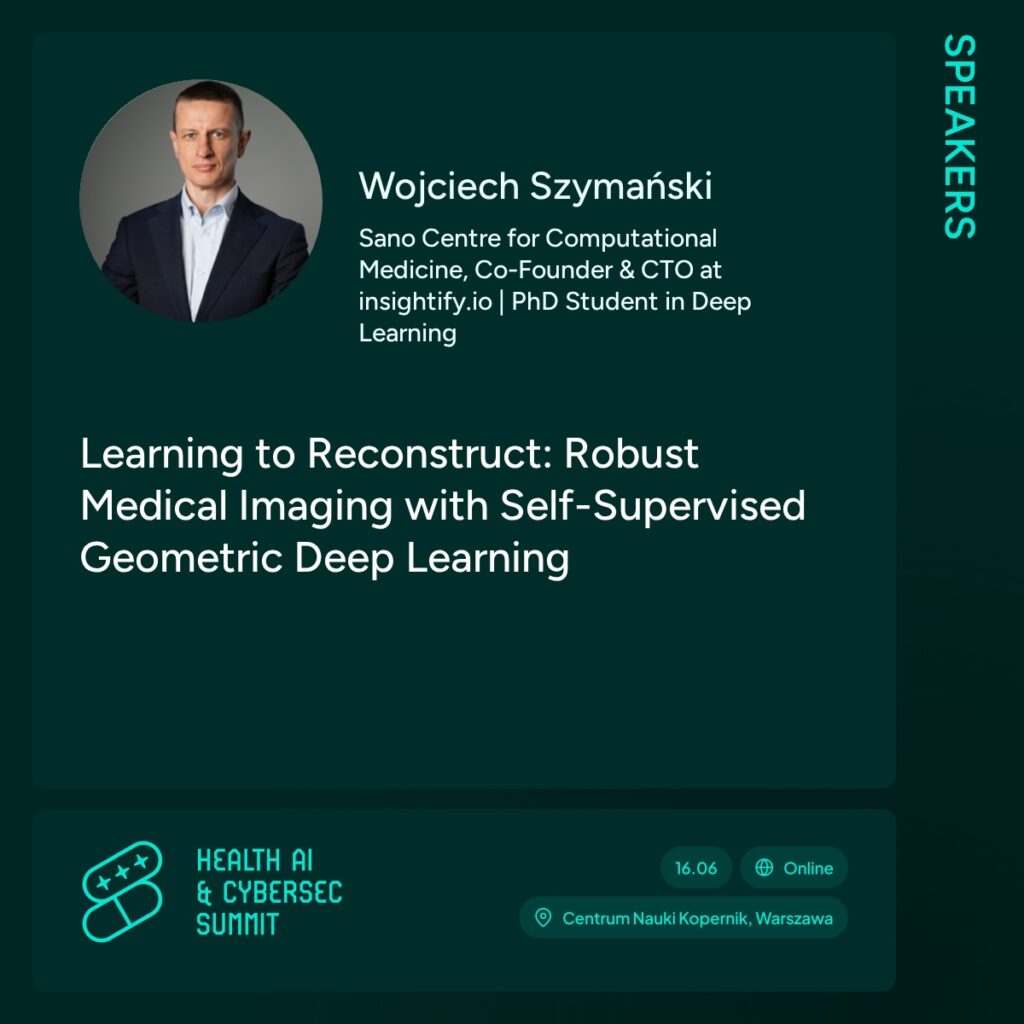
On 16 June, Sano researcher Wojciech Szymański took the stage at the Health AI & CyberSec Summit (HAICS) in Warsaw, a meeting held at the Copernicus Science Centre that brought together two communities not often in the same room: healthcare cybersecurity and healthcare AI. Drawing on the Hack Summit and Data Science Summit, the programme spanned data protection, medical imaging and the growing role of artificial intelligence across the health and pharmaceutical sector.
Wojciech presented part of his PhD research on a stubborn problem in medical imaging: how to make the reconstruction of 3D anatomical structures more reliable. Scans are rarely perfect. Parts of an organ or vessel can be missing, noisy or distorted, and a model trained to rebuild them usually needs large collections of examples that a person has painstakingly labelled by hand. Preparing those labels is slow and costly, and it limits how far such models can scale.
Wojciech presented part of his PhD research on a stubborn problem in medical imaging: how to make the reconstruction of 3D anatomical structures more reliable. Scans are rarely perfect. Parts of an organ or vessel can be missing, noisy or distorted, and a model trained to rebuild them usually needs large collections of examples that a person has painstakingly labelled by hand. Preparing those labels is slow and costly, and it limits how far such models can scale.
His answer is a framework called Defect API. Instead of relying on hand-prepared data, it generates synthetic structural defects during training: it deliberately damages complete examples in configurable, realistic ways, then asks the model to restore them. Because the correct answer is simply the undamaged original, the model can learn on its own, an approach known as self-supervised learning, with nobody labelling anything. The framework works with both voxel grids and point clouds, two common ways of representing 3D shapes, and it has been connected to well-established architectures including nnU-Net and Point Transformer V3.
Tested on large, varied medical datasets, the method pointed to a clear lesson: the diversity and realism of the training defects strongly shape how robust the model becomes and how well it generalises to data it has not seen before. Put plainly, the quality of the “damage” a model learns from can matter as much as the model itself.
Wojciech closed with a live demonstration of the full pipeline, from training the model and tracking its progress in TensorBoard to an interactive 3D view of the reconstructed anatomy. Seeing the whole chain run end to end, rather than a set of final numbers on a slide, made the method easy to grasp for an audience drawn from very different backgrounds.
For Sano, the talk is a good example of how careful methodological work in AI feeds directly into the tools that clinicians and researchers may one day rely on. We congratulate Wojciech on the presentation.