The Two Lives of Visual Memory
On 12 November, Dr Renate Rutiku from Jagiellonian University will show at Neuropizza that what we experience and what we remember accurately may come from different representations in the mind.
On 12 November, Dr Renate Rutiku from Jagiellonian University will show at Neuropizza that what we experience and what we remember accurately may come from different representations in the mind.
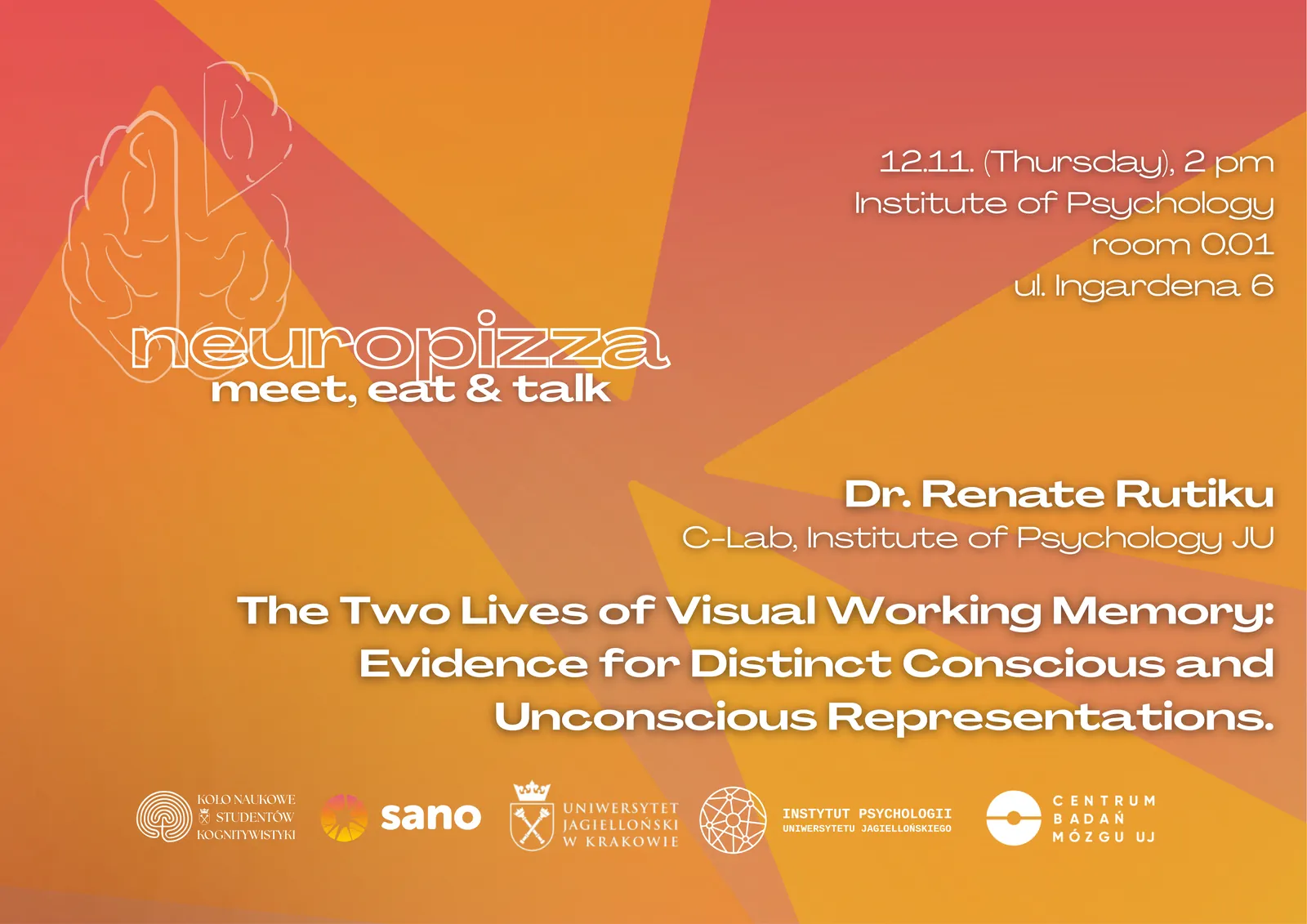
Our Neuropizza series continues with a talk that starts from a simple question: what do we really hold in mind when we remember an image for a few seconds? Join us on Thursday, 12 November, at 2 pm in room 0.01 at the Institute of Psychology of Jagiellonian University (ul. Ingardena 6, Kraków). Our guest will be Dr Renate Rutiku from C-Lab at the Institute of Psychology JU. She will present the talk “The Two Lives of Visual Working Memory: Evidence for Distinct Conscious and Unconscious Representations”.
Visual working memory allows us to keep a picture of the world in mind after it disappears from view. Scientists often link it to conscious experience and mental imagery. At the same time, most models describe it as a store of separate, independent items. These two views are hard to reconcile, because our conscious experience feels unified.
Dr Rutiku and her colleagues tested whether visual working memory relies on at least two kinds of representation. The first is an unconscious memory trace. The second is an integrated representation that we can consciously access. In a study with 216 participants, people performed a change-detection task and rated how clearly they experienced the remembered display. The researchers also changed the average size of the items and how much their sizes varied.
The results point in two directions. Participants reported a stronger experience of displays with larger and more varied items. Yet they answered more accurately when the items were smaller and more uniform. Subjective awareness still predicted performance, and even wrong answers showed consistent biases rather than random guesses. People with more vivid mental imagery reported higher awareness, but they were not more accurate.
These findings suggest that our answers in memory tasks can draw on both unconscious and conscious representations. Our experience may reflect a summary of the whole scene, while accuracy depends more on details of single items. During the talk, Dr Rutiku will discuss what this means for research on memory and consciousness.
Neuropizza is a meet, eat & talk series organised by the Cognitive Science Students’ Society, Sano, the Institute of Psychology JU and the Brain Research Centre JU. Come for the science and stay for the pizza and discussion.