
Validation of eleven federated learning strategies for multi-contrast image-to-image MRI data synthesis from heterogeneous sources
New Publication
We are pleased to share that a new paper co-authored by Jan Fiszer, Dominika Ciupek, and Maciej Malawski from the Sano Centre for Computational Medicine, together with Tomasz Pieciak, has been published in Biomedical Signal Processing and Control, titled “Validation of eleven federated learning strategies for multi-contrast image-to-image MRI data synthesis from heterogeneous sources.” This publication is a continuation of the abstract presented at the ISMRM conference.
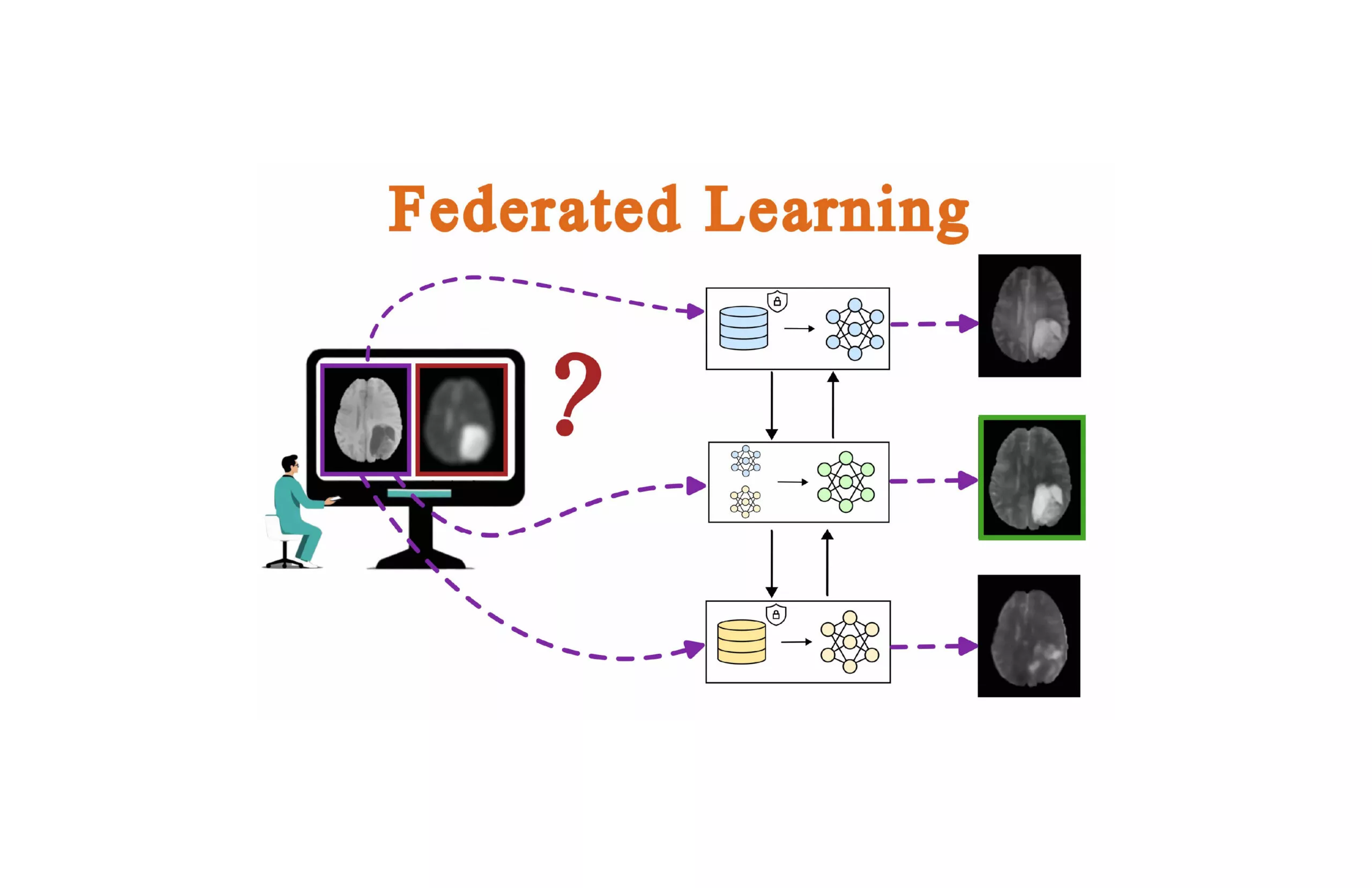
The study focuses on applying federated learning (FL) techniques to medical image synthesis, enabling collaborative model training across institutions without the need to exchange sensitive patient data. This decentralized approach helps overcome one of the key challenges in deep learning for medical imaging – data heterogeneity across sites and scanners.
In their work, the authors thoroughly validated eleven federated learning strategies for image-to-image MRI translation tasks using multi-contrast brain scans, including both healthy and tumorous cases, sourced from five different institutions. The paper introduces a novel aggregation method called FedBAdam, which combines the strengths of two existing techniques by incorporating momentum into the aggregation process and skipping batch normalization layers.
Results show that FedBAdam outperforms standard federated aggregation methods in terms of evaluation metrics: mean squared error (MSE) and structural similarity index (SSIM), while offering more stable convergence and preventing model overfitting in complex multi-site and multi-vendor environments.
This publication marks a significant step toward secure and efficient deep learning applications in medical imaging, fostering collaboration between institutions without compromising data privacy. Moreover, it opens new, easy-to-implement paths for developing robust FL methods by proving that combining existing complementary approaches is effective.
Read the full article in Biomedical Signal Processing and Control.
Code: