
Digital lifelines in practice
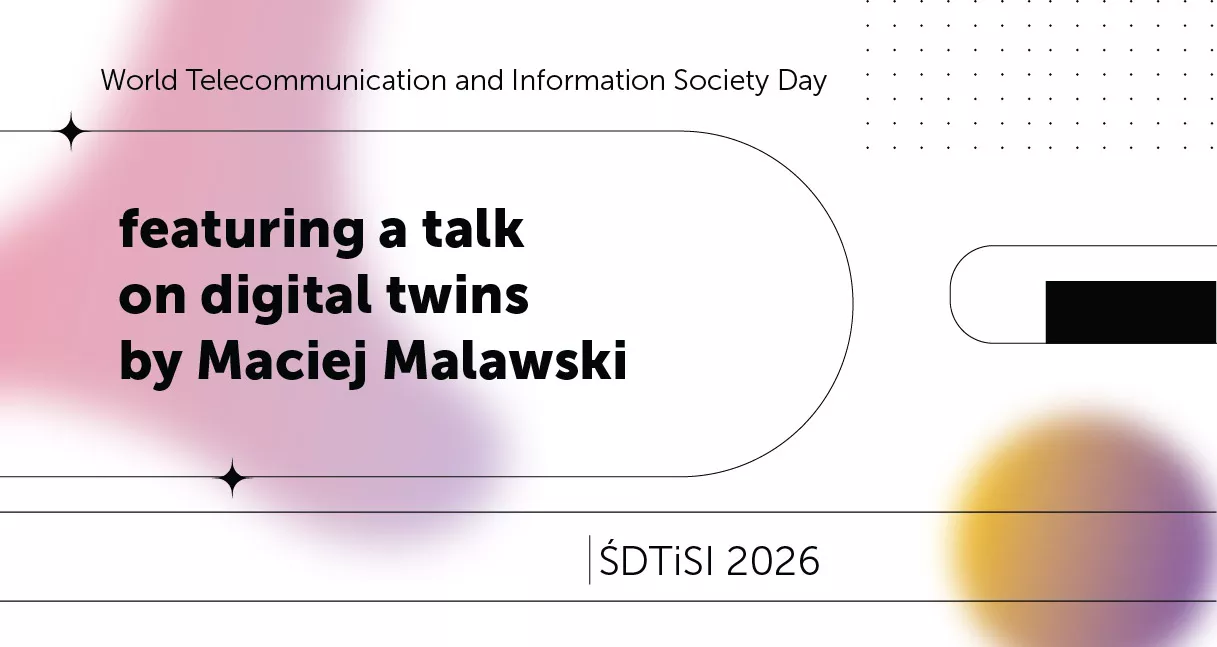
Maciej Malawski at World Telecommunication and Information Society Day (ŚDTiSI) 2026 with a talk on digital twins
World Telecommunication and Information Society Day (Światowy Dzień Telekomunikacji i Społeczeństwa Informacyjnego – ŚDTiSI) is one of the most important annual events for the ICT community in Poland, bringing together experts, practitioners, and policymakers to discuss how connectivity and digital technologies shape our society and economy. Since 2007, the Polish celebrations have built a strong position as a national forum for exchanging ideas, showcasing innovation, and promoting the development of modern telecommunications and digital infrastructure.
This year’s edition takes place under the motto “Digital lifelines – Strengthening resilience in a connected world”, highlighting the growing role of digital systems in ensuring continuity of services, security, and social well-being. In this context, the conference will focus not only on technology itself, but also on the challenges, opportunities, and risks that come with an increasingly interconnected world.
Modern computing in practice: talk by Maciej Malawski
During the thematic session “Modern computing in practice”, Maciej Malawski, Director of Sano Centre for Computational Medicine, will give a talk titled “Digital twins in important practical applications”. His contribution will be one of several presentations illustrating how contemporary computing solutions are used in real-world contexts, including medicine and other critical domains.
At Sano, researchers develop methods in computational medicine, including large-scale data processing, modelling and simulation, and AI-based tools to support diagnosis and treatment. Digital twins are a key element of this work: virtual representations of systems, patients, or processes that allow experts to test scenarios, analyse risks, and optimise interventions before they are applied in the real world. By bringing this perspective to ŚDTiSI 2026, Maciej Malawski will show how computational medicine fits into the broader conversation on digital resilience and the future of ICT.
Three thematic sessions on ICT, AI, and skills
The 2026 conference programme includes three main thematic sessions: “Modern computing in practice”, “Artificial intelligence: new opportunities and threats”, and “Development of specialised digital competences”. Together, they offer a comprehensive overview of current trends in ICT, from practical implementations and AI adoption to building the skills needed in a data-driven economy.
This year’s sessions will summarise insights from previous editions and outline perspectives for the further development of information technologies, as well as the benefits, challenges, and risks they bring for society and economic growth. The event will feature renowned scientists, business leaders, and representatives of public administration and local government, reflecting the need for close cooperation between research, industry, and policy.
ŚDTiSI and the role of ITU
World Telecommunication and Information Society Day (WTISD / ŚDTiSI) is coordinated globally by the International Telecommunication Union (ITU), the United Nations specialised agency for ICTs. The purpose of WTISD is to raise awareness of the possibilities that the Internet and other information and communication technologies bring to societies and economies, as well as ways to bridge the digital divide.
In 2005, during the World Summit on the Information Society (WSIS), the idea of establishing a World Information Society Day was proposed to emphasise the importance of ICTs in social and economic development. In 2006, the UN decided to combine World Telecommunication Day and World Information Society Day into a single observance: World Telecommunication and Information Society Day (WTISD). Each year, the day is marked on 17 May, commemorating the signing of the first International Telegraph Convention and the creation of the ITU.
Special issue of “DOMENA” and PTI’s 45th anniversary
Ahead of the conference, a special issue of the PTI journal “DOMENA” will be published, featuring articles by the speakers that expand on the topics presented in each thematic session. This publication will offer readers an opportunity to dive deeper into current research, case studies, and expert perspectives on ICT, AI, and digital competences.
In 2026, the Polish Information Processing Society (Polskie Towarzystwo Informatyczne, PTI) also celebrates the 45th anniversary of its founding. Established in 1981, PTI is the oldest Polish association bringing together IT professionals and enthusiasts from different sectors, and it has played a key role in shaping the domestic ICT landscape. The jubilee, combined with the ŚDTiSI celebrations, further underlines the long-term commitment of the Polish ICT community to building a modern information society.
Sano’s perspective: digital resilience in healthcare
The participation of Maciej Malawski in the “Modern computing in practice” session resonates strongly with Sano’s mission to advance computational medicine and in silico methods for healthcare. By integrating large-scale data analysis, high-performance computing, and AI-based models, Sano develops tools that can support clinicians, improve diagnostics, and help design more effective and personalised therapies.
In a world where healthcare systems are increasingly dependent on digital infrastructure, such solutions become an important “digital lifeline” — strengthening the resilience of medical services and improving their ability to respond to future challenges. Maciej Malawski’s contribution to ŚDTiSI 2026 will bring this perspective into a broader debate on how modern computing can help build a safer, more resilient, and more inclusive connected world.