
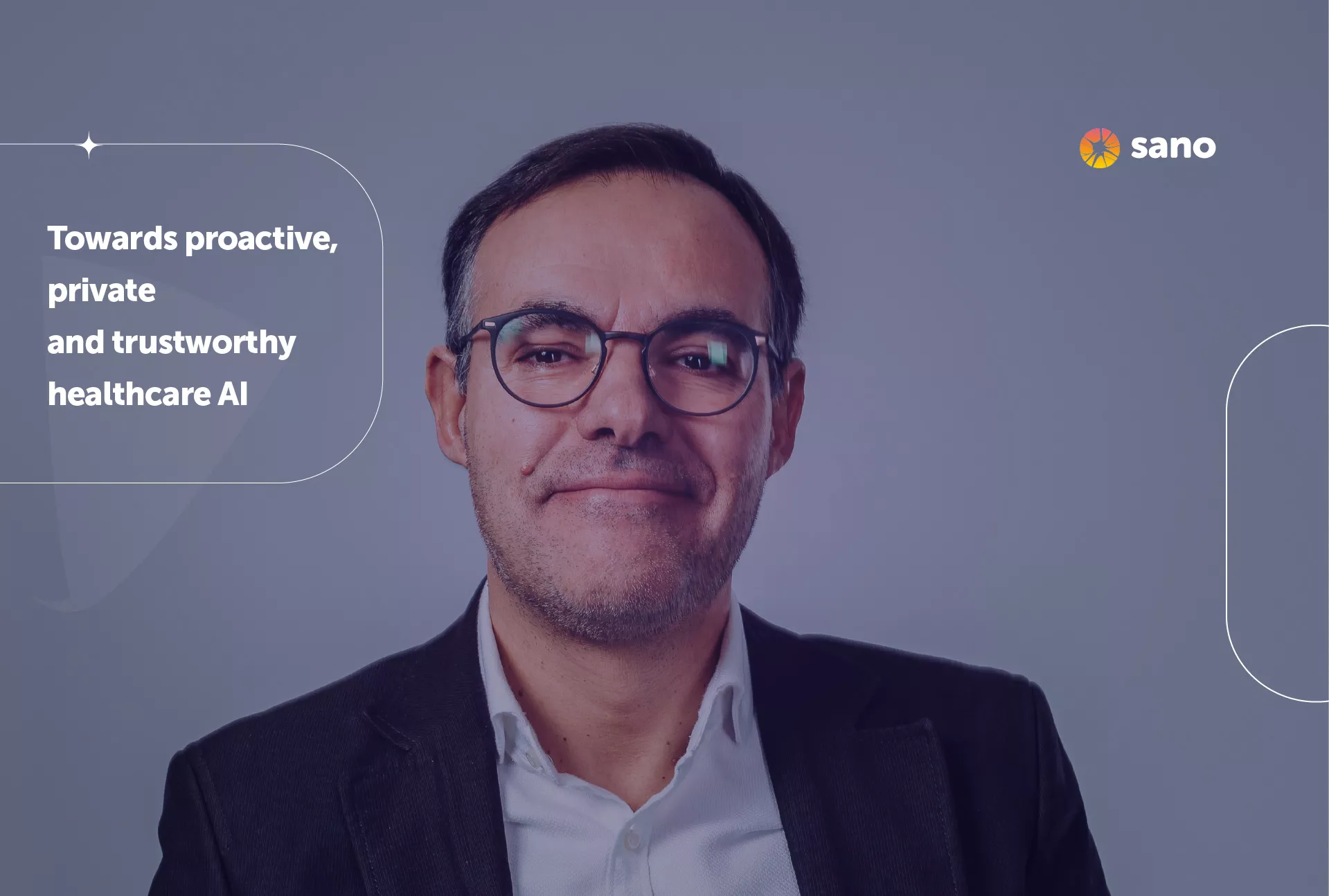
Towards proactive, private and trustworthy healthcare AI
Healthcare AI is at a turning point. Instead of relying on opaque, black-box prediction, a new generation of systems is emerging that reflects how diseases actually develop, protects patient data by design, and can earn the trust of clinicians.
At the Sano Centre for Computational Medicine in Kraków, the Computational Intelligence team led by Jose Sousa is helping to drive this shift toward more proactive, privacy-preserving and trustworthy AI in healthcare. Two recent international contributions show what this direction looks like in practice, from understanding the mechanisms behind chronic kidney disease to enabling secure learning across hospitals without moving patient data.
The first example was presented at CMBE 2026 in Kobe, Japan, in the work ‘A Combined Modelling and Machine Learning Approach to Differentiate Diabetic from Hypertensive Kidney Disease‘. Chronic kidney disease can look similar on the surface, even when it is driven by very different biological processes, and those differences matter for treatment and long-term care. By combining physiological modelling with machine learning, the study points to a way of distinguishing diabetic from hypertensive kidney disease more effectively, moving beyond one-size-fits-all prediction toward AI that is grounded in the mechanisms of disease.
A second contribution, presented at ICCS 2026 in Hamburg, Germany, addressed one of the biggest practical barriers in medical AI: how to learn from sensitive patient data distributed across institutions without compromising privacy. In the paper Rule-Based Federated Learning for Healthcare, a rule-based federated learning approach was used to enable learning across sites without transferring patient data, while also keeping the resulting models interpretable. This matters because privacy and trust are not separate goals in healthcare AI; they need to be built together if hospitals are to adopt such systems in real clinical settings.
This research direction also connects to a broader European effort. COST Action CA25101 aims to build a pan-European, multi-stakeholder pipeline for the detection, monitoring and prevention of infectious threats, while addressing challenges such as fragmented surveillance, poor interoperability and limited predictive modelling. As a member of the Management Committee of 1HEALTH-NET, Dr Jose Sousa contributes to a wider agenda in which AI-driven predictive models and interoperable health data can become shared infrastructure for collaboration, rather than isolated achievements within a single laboratory.
In that broader context, principles such as interpretability, privacy preservation and mechanism-grounded modelling can help shape standards and collaborations across Europe. The goal is not only to produce better-performing models, but to support the networks, frameworks and practices that allow trustworthy healthcare AI to scale. Interpretable, privacy-preserving and grounded in the mechanisms of disease, this is the direction in which healthcare AI is moving, and it is the direction needed for a system that can anticipate problems earlier and respond in ways that clinicians and patients can trust.
Learn more