
A summer of learning at the frontier
Three Sano researchers spent part of July at two leading international summer schools in Italy — one on computational fluid dynamics at GSSI in L'Aquila, the other on computer vision in Sicily.
This summer, three Sano researchers swapped their desks for lecture halls in Italy, joining two of the most respected international summer schools in their fields. For a computational medicine centre, such schools are more than a change of scenery. They are where early-career scientists pick up new methods, test their own work against an international audience, and build the connections that shape a research career.
In L’Aquila, Elena Gómez del Pozo attended a summer course on computational fluid dynamics (CFD) at the Gran Sasso Science Institute (GSSI), with her participation supported by Sano. CFD is the science of simulating how fluids move, and it sits close to Sano’s work on blood flow and the cardiovascular system. The course opened with a talk by Rajat Mittal of Johns Hopkins University, who showed how his group draws directly on nature to improve engineering design: comparing the acoustic signatures of mosquitoes and fruit flies to make drones quieter, borrowing the way tuna swim in schools to make ships more efficient, and using a simple ratio between jet length and left-ventricle length as a sharper predictor of thrombosis risk than the standard ejection fraction. The days that followed were given over to lectures and team workshops on numerical methods and on translating them to run on GPUs, the specialised processors that make large simulations faster. The thread running through it all, that nature has often solved an engineering problem long before we reach for it, sits well with a centre that models the human body to improve medicine.
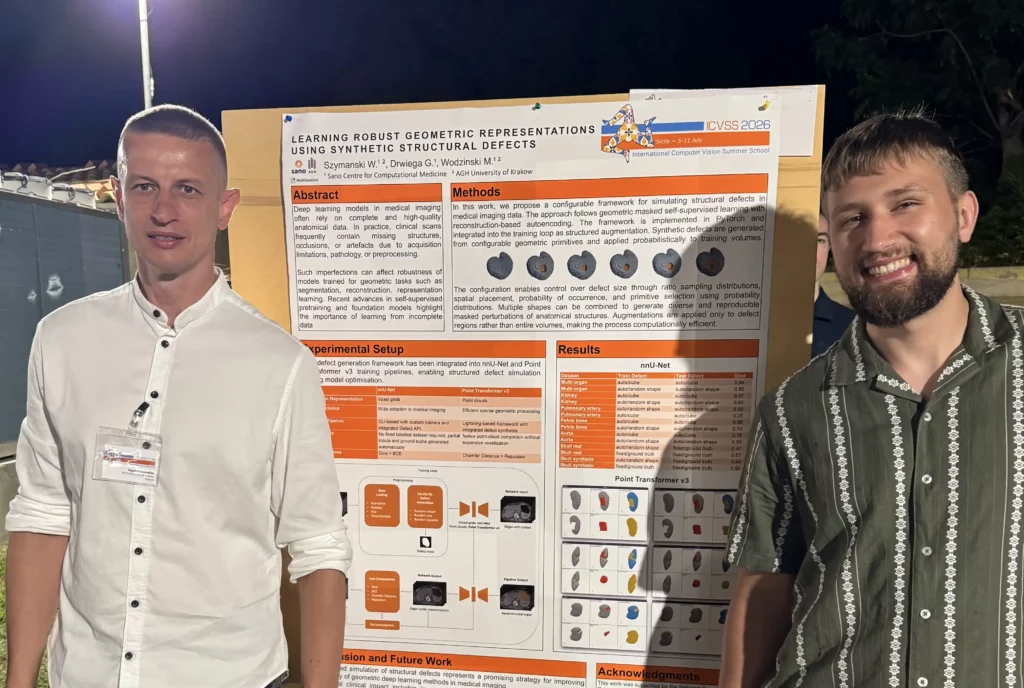

On the other side of the country, Wojciech Szymański and Gniewosz Drwięga travelled to Sicily for the International Computer Vision Summer School (ICVSS), held from 5 to 11 July near Scicli, in the province of Ragusa. Now in its twentieth year, ICVSS gathered more than two hundred PhD students, postdoctoral researchers and specialists around the theme of computer vision for spatial and physical intelligence, with lectures from researchers affiliated with institutions such as MIT, Stanford, Google DeepMind, NVIDIA and Meta.
During the school, Wojciech Szymański presented a poster on self-supervised learning for robust 3D shape reconstruction in medical imaging, an approach that lets a model learn useful structure from images without depending on large sets of hand-labelled data. The poster session was a chance to discuss the work and gather feedback from the international computer vision community. For both researchers, the week was equally about exchanging ideas, forming new connections and gaining insights that feed back into their work in medical imaging and artificial intelligence.
Two fields, two corners of Italy, one shared purpose: bringing the best of computational science back into the service of medicine. We congratulate Elena, Wojciech and Gniewosz, and look forward to seeing where these ideas lead.