
NEURONUS 2026
How Sano Researchers Are Decoding the Brain
A closer look at the brain
How can we read the brain’s hidden signals? Can we better predict the effects of stroke or understand the complexity of autism? These were some of the questions explored during the 14th edition of the NEURONUS & Young PTBUN Neuroscience Forum, held on April 24–26, 2026, in Kraków.
Organized by students of the Jagiellonian University, NEURONUS has grown into one of Europe’s leading neuroscience conferences. Every two years, it brings together researchers from around the world—from early-career scientists to established experts—to share discoveries, exchange ideas, and build collaborations across disciplines.
Sano on the scientific stage
Among the active contributors this year was the Sano team, whose members presented their work through both oral presentations and poster sessions. Their research highlighted how advanced data analysis and artificial intelligence are increasingly shaping modern neuroscience.
Agata Leszczak presented “Improving Ensemble Classification of Stroke Using Selection Pipeline” as both a talk and a poster. Her work focuses on refining machine learning models for stroke classification, with the potential to improve diagnostic accuracy and support more personalized treatment strategies.
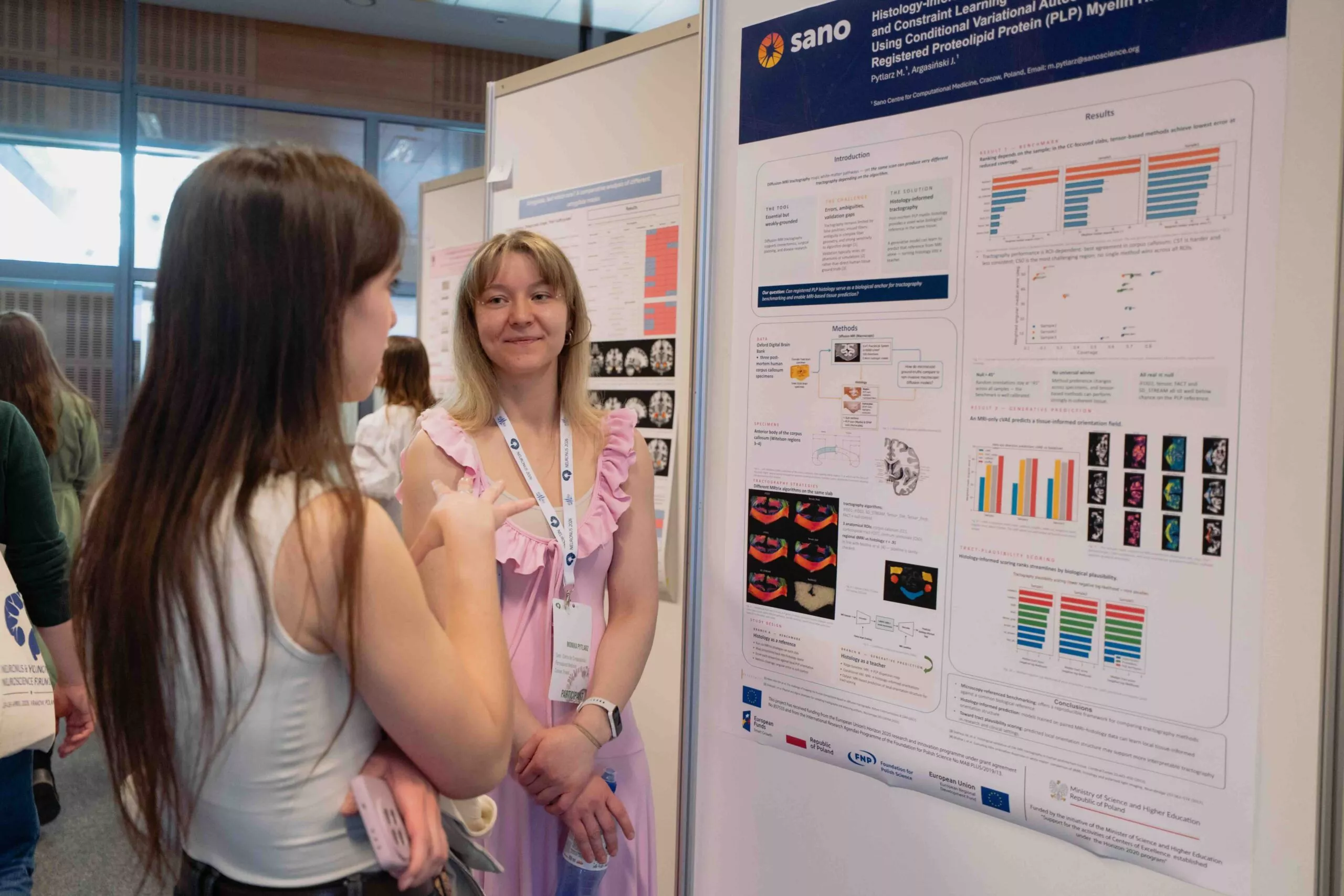
Monika Pytlarz also delivered both a presentation and a poster. Her project, “Histology-Informed Tractography Benchmark and Constraint Learning Using Conditional Variational Autoencoder and Registered Proteolipid Protein (PLP) Myelin Histology,” combines histological data with advanced generative models to better reconstruct the brain’s white matter structure.
Eye movements as a window into the brain
A strong theme across several Sano presentations was the use of eye movement patterns as indicators of brain function and dysfunction.
Katarzyna Libera, in her talk “Oculomotor Variability from Resting-State fMRI as a Longitudinal Marker of Structural Brain Alterations After Ischemic Stroke,” demonstrated how subtle variations in eye movements may serve as markers of long-term brain changes following stroke.
Mikołaj Turczyniak presented a poster titled “Decomposition of Phenotypic Heterogeneity in Autism Reveals Underlying Changes in Oculomotor Patterns,” exploring how differences in behavior across the autism spectrum relate to distinct eye movement patterns.
Zofia Sikorska, in her presentation “Optimizing CNNs for Detecting Low Amplitude Eye Movements from fMRI,” focused on improving neural networks capable of detecting extremely subtle eye movements from fMRI data—something that until recently remained out of reach.
Another contribution came from Rosmary Blanco, who delivered an oral presentation titled “Interpretable Machine Learning Framework Reveals Event-Related and Oscillatory EEG Signatures of Early Cognitive Decline Using a Portable Low-Density EEG Device and Emotive Stimulation Paradigm.” She presented the results of a proof-of-concept study focused on early detection of cognitive decline using portable EEG and explainable AI. The study involved recording EEG signals from 24 participants with a low-density portable device during a stimulation task, followed by the application of interpretable machine learning methods to identify neurophysiological biomarkers of early impairment. The proposed model achieved an AUROC of 0.93, while SHAP analysis highlighted changes in event-related potential (ERP) latency and oscillatory activity associated with early neurodegenerative processes. These findings point toward the potential of scalable, non-invasive EEG-based tools for accessible and objective dementia screening.
Where neuroscience meets AI
Together, these contributions reflect a broader shift in neuroscience: the growing integration of biology, medicine, and artificial intelligence. By combining these fields, researchers can uncover patterns that would otherwise remain invisible and develop tools with real clinical impact.
Sano’s presence at NEURONUS 2026 highlights the role of emerging researchers in shaping this future—bridging fundamental science with practical applications that may one day transform how we diagnose and treat neurological conditions.
Read about Sano workshops
Neuronus workshops